Today was another great day at ASH21, and antibodies (of course) took center stage in my choice of talks to attend.
Darzalex® (daratumumab), again, showed impressive results, this time in the ADROMENA trial for light-chain (AL) amyloidosis — a protein misfolding disease that can also occur in ~15% of multiple myeloma patients. These phase III trial results that were presented by Dr. Raymond Comenzo, MD, showed that the addition of Darzalex to Velcade/Cytoxin/dexamethasone (VCd) induction followed by Darzalex maintenance led to a 60% response rate compared to 20% in the VCd arm.
Most impressively, patients with renal or cardiac involvement showed improvements in organ function in the Dara-VCd arm. This talk was so moving to me because I lost a dear friend to AL amyloidosis years ago, which prompted me to switch my research focus to protein misfolding as a first step towards therapeutic development for protein misfolding diseases. I’m glad that there is now a good therapeutic option, at least for newly diagnosed AL amyloidosis patients.
Bispecific antibodies that targeted other sites besides BCMA have shown impressive results in preclinical and early clinical studies, offering options for patients who do not express BCMA on the surface of their myeloma cells.
Dr. Stefano Sammicheli, PhD, Director at Ichnos Sciences, presented early data on a first-in-class CD47/CD38 bispecific antibody innate cell modulator, ISB 1442. This antibody has two CD38+ epitopes that are distinct from daratumumab to bind myeloma cells as well as a CD47+ epitope to increase destruction of myeloma cells.
The preclinical data is impressive and first-in-human clinical trial enrollment is expected in mid-2022. Dr. Suzanne Trudel, MD presented data on the phase I clinical trial of another bispecific antibody, cevostamab — a FcRH5/CD3 bispecific antibody that facilitates the killing of myeloma cells. The safety profile is concerning, but a step-up dosing procedure seems to help, and it is a good option for relapsed, refractory patients who do not have an established treatment available for them.
Dr. Amrita Krishna, MD presented data on the MonumenTAL-1 Phase I study of talquetamab, a GCPRC5D/CD3 bispecific antibody that showed durable responses that deepened with time. A phase II expansion study is underway.
Additionally, Dr. Ajai Chari, MD presented results of the TRIMM-2 phase Ib study of talquetamab with daratumumab, which showed even deeper responses compared to monotherapy, with no increase in adverse effects. These data show that combination therapies with bispecific antibodies will be a promising future therapy option.
Dr. Sagar Lional, MD, FCAP gave an update on the phase 1/2 trial on iberdomide (IBER), a novel oral cereblon E3 ligase modulator (CelMoD), in combination with dexamethasone. While the overall response rate was low (26%) in this heavily pre-treated population, iberdomide is very well-tolerated with minimal side effects compared to other immunomodulators, likely because only the S isomer is administered so there are no off-target effects from the R enantiomer. The unique mode of action of CelMoDs warms this protein folder’s heart, and I expect to see future combination trials that will likely play an important role in new myeloma treatments.
In addition to novel antibody therapies, there were several interesting talks that focused on early precursors to myeloma and detection of myeloma in circulating plasma cells. In all of these talks, I was struck by how amazing the bone marrow environment can be.
Two trials that screened for MGUS indicated the importance of identifying patients at risk of progression to allow the best likelihood of treatment success. The first results on the IStopMM (Iceland Screens, Treats or Prevents Multiple Myeloma) Study were presented. Incredibly, half of the population over 40 in Iceland was screened for MGUS, and the estimated prevalence of smoldering myeloma was 0.5%, making a case for early detection. Another IStopMM talk showed that the presence of MGUS did not increase the risk of COVID-19.
Additionally, several interesting talks from the lab of Dr. Irene Ghobrial, MD were presented today. Results from the PROMISE Study showed increased incidence of MGUS in high-risk populations. Molecular profiling of circulating multiple myeloma cells can predict disease aggressiveness, and liquid biopsies can be predictors of immune response in high-risk smoldering myeloma. The idea of blood biopsies to detect myeloma is very appealing – who wouldn’t be happy to have fewer bone marrow biopsies!
In one final talk from the lab of Dr. C. Ola Landgren, MD, PhD the immune microenvironment in the blood and bone marrow is normalized when there is an MRD-negative response to lenalidomide maintenance. How cool is it that your bone marrow can reboot and normalize after treatment? The bone marrow environment sure is complex but so incredibly amazing!
Even my kitty, Miss Lili, was impressed by all the results we saw today at ASH21. I am hopeful that all these fascinating studies will translate into new therapies for myeloma patients in the future!
Dec 11, 2021 – The day began at 3:30 a.m. PST for the privilege of being able to attend the International Myeloma Working Group (IMWG) meeting. The IMWG has over 250 myeloma specialists who meet twice a year. The agenda included a review of current projects and a discussion of possible proposals to specifically produce guidelines for myeloma treatment. For example, in 2021, guidelines were produced for redefining plasma cell leukemia as 5% circulating plasma cell, infection prevention (very timely during this pandemic), bone disease, and the role of mass spectrometry. Ongoing projects include the management of renal failure, CAR T, and smoldering multiple myeloma (SMM) guidelines.
Then it was off to “virtually” attend a number of first-day oral abstract presentations. The format of these 15-minute talks is for the primary investigator to present their slides for 10 minutes and allow 5 minutes for questions. The hybrid nature of this year’s ASH — where facilitators, presenters, and the audience is a blend of in-person and virtual— made this quite a challenge. This format worked better as the day went on but did cause some information to be missed, if you attended virtually. [On the other hand, it snowed in Atlanta 2 years ago and I missed some information while being there in-person.]
These are my highlights from today’s presentations: [Abstract#]
Iceland
There were at least 3 studies presented from the iStopMM project, which is in its 5th year. If you’re not familiar with this project and its potential importance, check out Dr. Brian G.M. Durie’s recent blog video.
One essential question asked was whether or not we should screen for monoclonal gammopathy of undetermined significance (MGUS). Other diseases offer early screening, resulting in the improvement of overall survival so why shouldn’t this be true for MGUS, a possible precursor to myeloma? Over 75,000 individuals were screened with nearly 4,000 MGUS patients found and after 3 years of follow-up some have become SMM and myeloma patients. [156]
While this is a long-term study, several interesting outcomes have already been determined: 1) SMM occurs in 0.5% in persons 40 years or older but according to today’s risk stratification, only 1/3 of these SMM patients are considered intermediate or high risk; [151] 2) There is no relationship between MGUS and the susceptibility of either getting COVID-19 or the severity of it. [154]
Bispecific Antibodies
There were several updates provided on bispecific antibodies with more to come on Sunday and Monday. The Bispecifics often use 1-2 “step-up” doses (start with lower amounts) to mitigate potential cytokine release syndrome (CRS). Today, abstracts provided results for:
1) Cevostamab (FcRH5 marker on the MM cell x CD3 on the T cell) given every 3 weeks to n=161 patients (pts) heavily pre-treated (including prior BCMA) resulted in ORR of 57% and mDOR of 11.5 mos for dosing 132-198mg via IV; [157]
2) Talquetamab (GPRC5D x CD3) given SubQ to N=55 pts resulted in ORR 67-70%; [158]
3) And when talquetamab is combined with dara N=21 showed an ORR 77-85% (no dara within prior 90 days); [161]
4) REGN5458 (BCMAxCD3) N=73 provided ORR = 75% at the combined 200-800mg dose levels. [160]
Other Studies
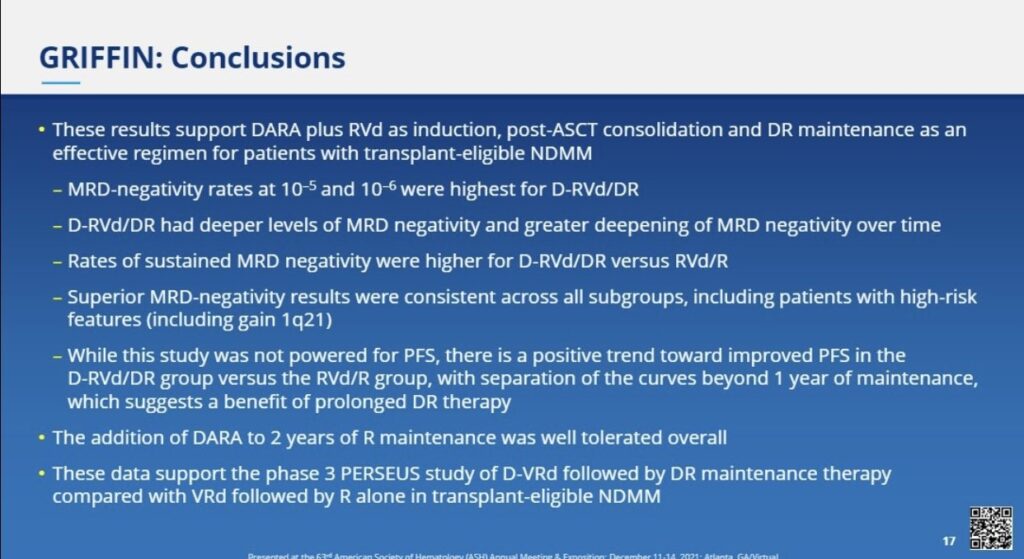
An update with a 2-year follow-up was provided for the Griffin study: [Dara]RVd -> SCT -> [D]RVd -> [D]R maintenance (2 yr). Dara arm results in superior outcomes after 2-year follow-up: MRD- (10-5) 64% vs 30%, CR 82% vs 61%, and MRD- >12 mos durability 44% vs 13%. [79]
Iberdomide (a CELMod) + dex demonstrates efficacy in triple-refractory patients, including those 100% refractory to IMIDs, ORR 26% N=26 and pts with previous BCMA, ORR 25% N=24. [162]
The PROMISE study examines potentially high-risk individuals, specifically Black/AA (N=2439) and those with first degree relative dx with hema malignancy or precursor to MM (N=3866). MGUS screening via both SPEP (6%) and Mass Spec (13%) confirmed both higher rates and increased sensitivity with Mass Spec. [153]
That’s it for tonight. While my first meeting tomorrow isn’t until 6:30 a.m. PST, one benefit of a virtual ASH is that many sessions are recorded and available for replay (just in case I oversleep).
Friday was a light day, program-wise. Even so, I was immersed quickly into the bright lights of ASH. I learned a lot by attending an excellent symposium, Adapting Clinical Practice to a Rapidly Changing Therapeutic Landscape in Multiple Myeloma, moderated by Dr. Brian Durie (IMF & Cedars-Sinai), and including myeloma specialists Dr. Jesus San-Miguel (University of Navarra, Spain), Dr. Philippe Moreau (University Hospital of Nantes, France), Dr. S. Vincent Rajkumar (Mayo Clinic, Rochester), and Dr. Thomas Martin (UCSF). This program detailed various case studies along the myeloma continuum.
The first dealt with smoldering multiple myeloma (SMM), which I’ll be focusing on: Evidence for Treating High Risk Smoldering Multiple Myeloma. The definition of high-risk smoldering myeloma (HRSMM) was reviewed, and the details of a case study were outlined. The experts weighed in on whether to treat or not, and if so, how? Interestingly, there wasn’t a consensus about treating, which highlights a challenge those with smoldering myeloma may face. Those who are high-risk can enter treatment through a clinical trial, and possibly off-trial, too, and thus clear-cut decision points don’t exist. The experts highlighted that the rationale for early treatment is either to delay progression or to cure the disease.
Discussion ensued, and it was really interesting to follow along with these specialists as they considered key data points and rationales for one approach over the other. In the end, I came up with these takeaways:
Patients with HRSMM should be followed very closely, approximately every two months, as progression consists of an evolving pattern of change.
Use SLiM CRAB for treatment guidance, as the goal is to treat before active CRAB symptoms are evident.
Progression is hard to capture at the moment, as it happens between visits (see #1 above).
Dr. San-Miguel predicted that the 2 in the 20/2/20 risk progression model may be replaced with .2 in the future.
Although not discussed, the question about who decides treatment in HRSMM arose. Specifically, how much input should patients have, or should the physician decide exclusively? I wish they discussed this.
Dr. Thomas emphasized the importance of gathering and observing trends in key myeloma markers; he wants to see “the movie,” versus individual snapshots.
December 11, Saturday
As the first official day of ASH 2021 began, I had the opportunity to sit in at the International Myeloma Working Group breakfast, where investigators shared some research highlights. This was fascinating as the best in the myeloma world asked questions and discussed recent findings…wow!
I also attended a variety of other presentations. A couple of key points that I’d like to share are as follows:
Results from the iStopMM (Iceland Screens, Treats, or Prevents Multiple Myeloma) project are coming out. If you don’t know about this project, it is really quite amazing! Iceland has been able to screen about half of its adult population (40+ years old, over 75,000 people) for MGUS and SMM, via M-protein and abnormal FLC ratio. The prevalence of SMM in the total population is estimated to be about .5%, with prevalence increasing with age. Of those with SMM, about a third were considered to have intermediate or high risk SMM. Risk was assessed with both the Mayo 20/2/20 model and the Spanish model, which resulted in 55% agreement. They concluded that a need for improved risk stratification exists. A future direction with this data is to continue to follow these individuals, as well as to explore the possibility of familial connections, correlations with autoimmune issues, and psychological outcomes related to knowledge of having SMM.
Early research is looking at the possibility of following smoldering myeloma via liquid biopsies (i.e., from plasma) versus bone marrow biopsies (BMB). BMBs, which are currently the “gold standard,” are invasive and often painful, and thus, are done at diagnosis and then later when other labs show that progression may be occurring. They also tend to be “patchy,” meaning that results are somewhat sample-dependent. Two papers (Garces and Dutta) highlighted the possibility of liquid biopsies, comparing results to BMB. The early work looks promising, so we’ll have to stay tuned in the coming few years on this front.
I’m not finished with Day 1 yet, as I’ll be attending one more oral session and then, at least six poster presentations. My general impressions are that ASH certainly brings the best and brightest together as they shine light in the myeloma space. I’m taking in as much as I can, and I hope that what I share is of interest and value to you!
The first official day of ASH activities started at 6:30 a.m. with the International Myeloma Working Group (IMWG) Breakfast Meeting. The IMWG is exactly that — a working group of myeloma experts from across the world, who come together periodically to investigate and create new guidelines for everything myeloma. They form different subgroups to review, collaborate, and make recommendations for new, up-to-date guidelines on many topics.
What a blessing it is to be in a room with this much talent and passion for myeloma! I feel very honored to have been given this opportunity to experience such collaboration and cooperation between experts for the good of myeloma patients all over the world.
Now, on to the oral presentations. Some highlights from Day 1 include:
Exciting information coming from the most recent update of the Griffin Study. This study is looking at Dara plus RVd in patients with ASCT eligible Newly Diagnosed MM and updated analysis includes subjects after 24 months maintenance treatment. It appears that the quad therapy yielded 81% MRD negative subjects vs the 44% with only the triplet VRd therapy. We know that sustained MRD Negativity is more important than one snapshot, but so far, 6-month and 12-month MRD negativity remain improved with quad therapy. Will this study further direct quad therapy as SOC in induction therapy and then dual therapy in the maintenance phase?
Also, final analysis of the BELLINI study supports a biomarker-driven approach in the current Venetoclax development program in t (11;14) RRMM. Consistent results from this study are showing improvement in PFS and OS in patients with t (11;14) or BCL2 high expression.
Liquid biopsies are gaining strength in research! Will checking circulating plasma cells in initial workups of patients and monitoring throughout disease management be the new standard, rather than serial bone marrow biopsies?
For many studies, one of the AIMS is to eliminate dexamethasone from the commonly used regimens. This is good news when it comes to quality of life for myeloma patients. In the future, we may be able to remove this drug that, while effective, causes many patients so many side effects that affect quality of life.
Bispecific antibodies are up and coming! Different targets are being researched including BCMA and GPRC5D, among others. Promising data from Phase I studies, doses are being escalated and safety profiles are being identified.
iStopMM is a screening that is an unbelievably HUGE undertaking, giving endless amounts of data and assuredly, for years to come! Symptomatic screening for MGUS hasn’t been studied before, and the study’s aim states to determine if early detection can lead to the possibility of cure. Less than 2-6% of myeloma patients are diagnosed at precursor states. So how can we find them early? This Icelandic study had around 150,000 subjects show interest, with about 75,000 screened in the study. Of this group, 3,725 patients were found to have MGUS. Then this group blindly randomized into 3 arms: Arm 1 (current standard of care), Arm 2 (current IMWG guidelines), and then Arm 3 (more intensive follow-up). Initial findings are promising, but no recommendations are to be made until further research continues. Additional study looked into MGUS and COVID-19. Of 72,000 eligible subjects, 32,000 were tested. Results show that MGUS does NOT increase risk of contracting COVID, nor does it make the effects of the virus more severe, if infected. GOOD NEWS! Ideas for future research on this study population include evidence of chronic allergies/auto immune diseases/familial linkage —an important and expansive research!
Reports given for dose expansion phase of iberdomide — a novel IMiD therapy, like Rev/Pom, but big differences exist. Iberdomide is tumoricidal, while Rev/Pom are not. Also, side effect profiles are completely different, as iberdomide appears to be more easily tolerated, with typical IMiD-related events like GI effects, rash, and fatigue not noted. This is exciting news, again, for quality of life!
Final thoughts of the day: new and upcoming promising therapies are simply not cost-efficient or accessible for most patients. How do we improve access to these new therapies that can offer so much hope? For some patients that do not have access to large academic centers with myeloma specialists actively involved in their care, will these therapies remain unreachable to them? How do we bridge the gap? Food for thought!
Also, I am grateful that so many studies have a focus of improving quality of life for patients. This should ALWAYS be the AIM. Some thoughts from an oncology nurse, who is passionate about myeloma and from our 10-month-old, 110-lb. Newfoundland puppy, Bean, who just wants to have some attention today.
Welcome to ASH 2021. This year, it’s hybrid-style! ASH is monitoring the recent discovery of the Omicron variant and is proceeding with a hybrid meeting to include both in-person and virtual options.
I’m grateful to the IMF for deciding months ago that the patients/support group leaders who will be attending #ASH21 will be participating virtually with us. While I will miss connecting with everyone and the excitement brought about by in-person meetings, patient health & safety is always top priority.
Fortunately, we will still be able to attend all oral and poster presentations virtually; we will be reporting to you through blogs and tweets. Please follow all the leaders on this page and search for these hashtags: #ASH21, #IMFASH21, #myeloma #mmsm
My husband Michael and I have had the opportunity to travel with Dr. Brian G. M. Durie and Susie Durie to Iceland in 2018 and 2019 to hear the research updates from the iStopMM team (Iceland Screens, Treats, or Prevents Multiple Myeloma). This is the first large-scale screening study aimed at preventing myeloma before it develops. The first results of the iStopMM screening study were published in May 2021.
There will be four iStopMM oral presentations and an additional two abstracts presented as posters at #ASH21. Dr. Durie outlined them in his recent blog which you can read here.
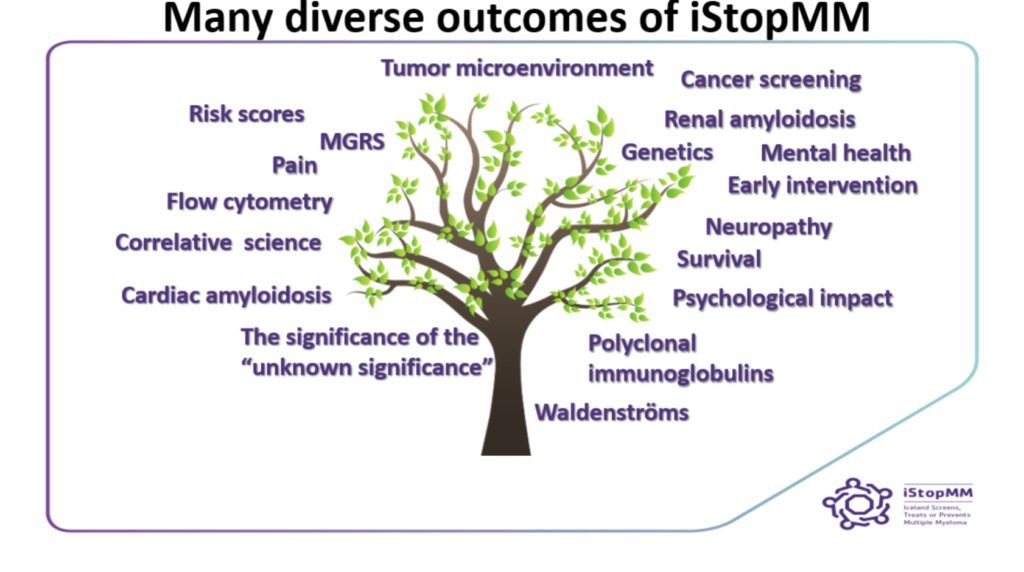
When we were at the iStopMM meetings in Iceland, Dr. Sigurdur Kristinsson and Dr. Saemundur Rognvaldsson presented an early version of the Tree below. The branches of this iStopMM Tree have certainly grown and as you can see, there are many diverse outcomes. I’ll try to incorporate one or two of these branches in each of my blogs.
Today, I will go over two branches from the Tree that Dr. Rognvaldsson shared with me:
Cancer screening – The iStopMM project is a population-based screening where blood samples are collected in a pragmatic and large-scale way. The iStopMM method of collecting samples passively for screening can become a model of cancer screening in the future, especially with the advent of new blood sample-based cancer screening methods.
Genetics – The iStopMM team is collaborating with deCODE genetics to do a deep analysis of the genetics of tumor cells and the genetics of people who have MM and its precursors. This can help us understand why genes and genetic mutations lead to the development of myeloma. Unique to iStopMM, repeated sampling and follow-up over time will allow us to watch these genetic changes happen from our germline genetical makeup (normal genetic makeup at birth) to the mutations leading to MGUS and then to the development of active myeloma. By understanding this timeline, we will be able to open new avenues in treating and preventing myeloma.
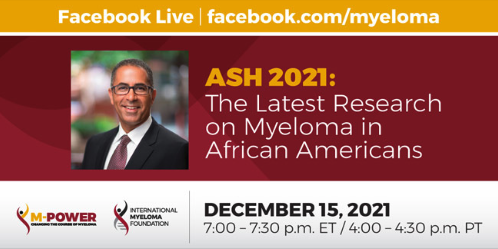
In closing, I will leave you with a calendar of IMF ASH links. Make sure to tune in next week as much as possible:
Friday, December 10
IMF ASH Satellite Symposium: “Adapting Clinical Practice to a Rapidly Changing Therapeutic Landscape in Multiple Myeloma”





You must be logged in to post a comment.