
Today was another great day at ASH21, and antibodies (of course) took center stage in my choice of talks to attend.
Darzalex® (daratumumab), again, showed impressive results, this time in the ADROMENA trial for light-chain (AL) amyloidosis — a protein misfolding disease that can also occur in ~15% of multiple myeloma patients. These phase III trial results that were presented by Dr. Raymond Comenzo, MD, showed that the addition of Darzalex to Velcade/Cytoxin/dexamethasone (VCd) induction followed by Darzalex maintenance led to a 60% response rate compared to 20% in the VCd arm.
Most impressively, patients with renal or cardiac involvement showed improvements in organ function in the Dara-VCd arm. This talk was so moving to me because I lost a dear friend to AL amyloidosis years ago, which prompted me to switch my research focus to protein misfolding as a first step towards therapeutic development for protein misfolding diseases. I’m glad that there is now a good therapeutic option, at least for newly diagnosed AL amyloidosis patients.
Bispecific antibodies that targeted other sites besides BCMA have shown impressive results in preclinical and early clinical studies, offering options for patients who do not express BCMA on the surface of their myeloma cells.
Dr. Stefano Sammicheli, PhD, Director at Ichnos Sciences, presented early data on a first-in-class CD47/CD38 bispecific antibody innate cell modulator, ISB 1442. This antibody has two CD38+ epitopes that are distinct from daratumumab to bind myeloma cells as well as a CD47+ epitope to increase destruction of myeloma cells.
The preclinical data is impressive and first-in-human clinical trial enrollment is expected in mid-2022. Dr. Suzanne Trudel, MD presented data on the phase I clinical trial of another bispecific antibody, cevostamab — a FcRH5/CD3 bispecific antibody that facilitates the killing of myeloma cells. The safety profile is concerning, but a step-up dosing procedure seems to help, and it is a good option for relapsed, refractory patients who do not have an established treatment available for them.
Dr. Amrita Krishna, MD presented data on the MonumenTAL-1 Phase I study of talquetamab, a GCPRC5D/CD3 bispecific antibody that showed durable responses that deepened with time. A phase II expansion study is underway.
Additionally, Dr. Ajai Chari, MD presented results of the TRIMM-2 phase Ib study of talquetamab with daratumumab, which showed even deeper responses compared to monotherapy, with no increase in adverse effects. These data show that combination therapies with bispecific antibodies will be a promising future therapy option.
Dr. Sagar Lional, MD, FCAP gave an update on the phase 1/2 trial on iberdomide (IBER), a novel oral cereblon E3 ligase modulator (CelMoD), in combination with dexamethasone. While the overall response rate was low (26%) in this heavily pre-treated population, iberdomide is very well-tolerated with minimal side effects compared to other immunomodulators, likely because only the S isomer is administered so there are no off-target effects from the R enantiomer. The unique mode of action of CelMoDs warms this protein folder’s heart, and I expect to see future combination trials that will likely play an important role in new myeloma treatments.
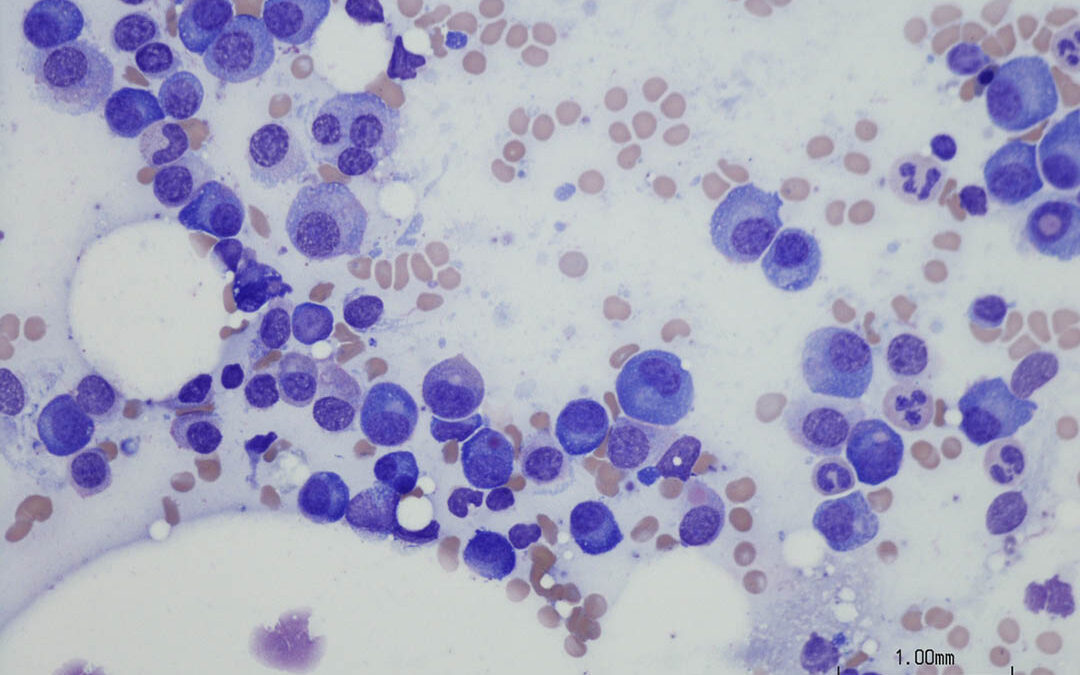
In addition to novel antibody therapies, there were several interesting talks that focused on early precursors to myeloma and detection of myeloma in circulating plasma cells. In all of these talks, I was struck by how amazing the bone marrow environment can be.
Two trials that screened for MGUS indicated the importance of identifying patients at risk of progression to allow the best likelihood of treatment success. The first results on the IStopMM (Iceland Screens, Treats or Prevents Multiple Myeloma) Study were presented. Incredibly, half of the population over 40 in Iceland was screened for MGUS, and the estimated prevalence of smoldering myeloma was 0.5%, making a case for early detection. Another IStopMM talk showed that the presence of MGUS did not increase the risk of COVID-19.
Additionally, several interesting talks from the lab of Dr. Irene Ghobrial, MD were presented today. Results from the PROMISE Study showed increased incidence of MGUS in high-risk populations. Molecular profiling of circulating multiple myeloma cells can predict disease aggressiveness, and liquid biopsies can be predictors of immune response in high-risk smoldering myeloma. The idea of blood biopsies to detect myeloma is very appealing – who wouldn’t be happy to have fewer bone marrow biopsies!
In one final talk from the lab of Dr. C. Ola Landgren, MD, PhD the immune microenvironment in the blood and bone marrow is normalized when there is an MRD-negative response to lenalidomide maintenance. How cool is it that your bone marrow can reboot and normalize after treatment? The bone marrow environment sure is complex but so incredibly amazing!
Even my kitty, Miss Lili, was impressed by all the results we saw today at ASH21. I am hopeful that all these fascinating studies will translate into new therapies for myeloma patients in the future!
Now, that is something to smile (or purr) about!
Jill Zitzewitz, PhD, on Twitter @JillZitzewitz