

The first official day of ASH activities started at 6:30 a.m. with the International Myeloma Working Group (IMWG) Breakfast Meeting. The IMWG is exactly that — a working group of myeloma experts from across the world, who come together periodically to investigate and create new guidelines for everything myeloma. They form different subgroups to review, collaborate, and make recommendations for new, up-to-date guidelines on many topics.
What a blessing it is to be in a room with this much talent and passion for myeloma! I feel very honored to have been given this opportunity to experience such collaboration and cooperation between experts for the good of myeloma patients all over the world.
Now, on to the oral presentations. Some highlights from Day 1 include:
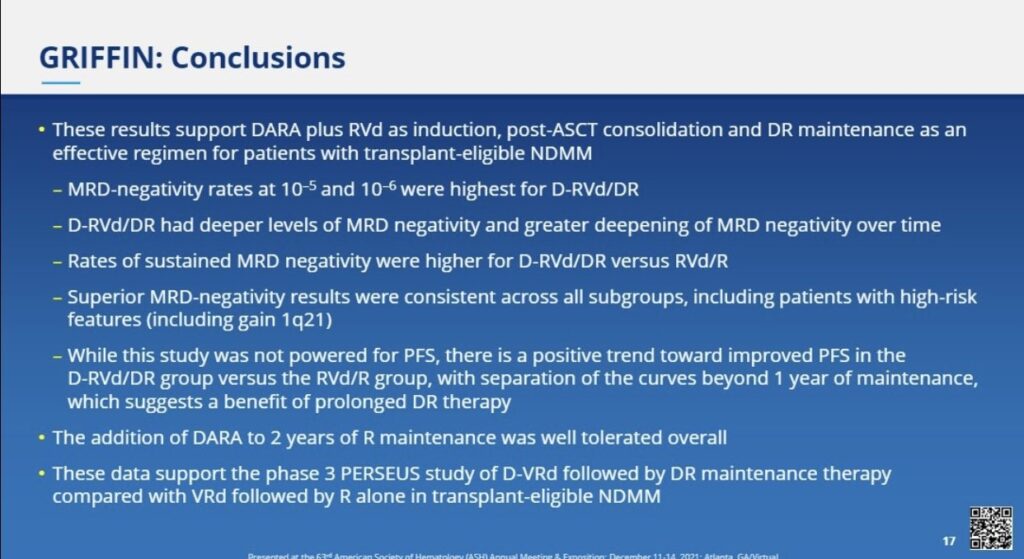
- Exciting information coming from the most recent update of the Griffin Study. This study is looking at Dara plus RVd in patients with ASCT eligible Newly Diagnosed MM and updated analysis includes subjects after 24 months maintenance treatment. It appears that the quad therapy yielded 81% MRD negative subjects vs the 44% with only the triplet VRd therapy. We know that sustained MRD Negativity is more important than one snapshot, but so far, 6-month and 12-month MRD negativity remain improved with quad therapy. Will this study further direct quad therapy as SOC in induction therapy and then dual therapy in the maintenance phase?
- Also, final analysis of the BELLINI study supports a biomarker-driven approach in the current Venetoclax development program in t (11;14) RRMM. Consistent results from this study are showing improvement in PFS and OS in patients with t (11;14) or BCL2 high expression.
- Liquid biopsies are gaining strength in research! Will checking circulating plasma cells in initial workups of patients and monitoring throughout disease management be the new standard, rather than serial bone marrow biopsies?
- For many studies, one of the AIMS is to eliminate dexamethasone from the commonly used regimens. This is good news when it comes to quality of life for myeloma patients. In the future, we may be able to remove this drug that, while effective, causes many patients so many side effects that affect quality of life.
- Bispecific antibodies are up and coming! Different targets are being researched including BCMA and GPRC5D, among others. Promising data from Phase I studies, doses are being escalated and safety profiles are being identified.
- iStopMM is a screening that is an unbelievably HUGE undertaking, giving endless amounts of data and assuredly, for years to come! Symptomatic screening for MGUS hasn’t been studied before, and the study’s aim states to determine if early detection can lead to the possibility of cure. Less than 2-6% of myeloma patients are diagnosed at precursor states. So how can we find them early? This Icelandic study had around 150,000 subjects show interest, with about 75,000 screened in the study. Of this group, 3,725 patients were found to have MGUS. Then this group blindly randomized into 3 arms: Arm 1 (current standard of care), Arm 2 (current IMWG guidelines), and then Arm 3 (more intensive follow-up). Initial findings are promising, but no recommendations are to be made until further research continues. Additional study looked into MGUS and COVID-19. Of 72,000 eligible subjects, 32,000 were tested. Results show that MGUS does NOT increase risk of contracting COVID, nor does it make the effects of the virus more severe, if infected. GOOD NEWS! Ideas for future research on this study population include evidence of chronic allergies/auto immune diseases/familial linkage —an important and expansive research!
- Reports given for dose expansion phase of iberdomide — a novel IMiD therapy, like Rev/Pom, but big differences exist. Iberdomide is tumoricidal, while Rev/Pom are not. Also, side effect profiles are completely different, as iberdomide appears to be more easily tolerated, with typical IMiD-related events like GI effects, rash, and fatigue not noted. This is exciting news, again, for quality of life!
Final thoughts of the day: new and upcoming promising therapies are simply not cost-efficient or accessible for most patients. How do we improve access to these new therapies that can offer so much hope? For some patients that do not have access to large academic centers with myeloma specialists actively involved in their care, will these therapies remain unreachable to them? How do we bridge the gap? Food for thought!

Also, I am grateful that so many studies have a focus of improving quality of life for patients. This should ALWAYS be the AIM. Some thoughts from an oncology nurse, who is passionate about myeloma and from our 10-month-old, 110-lb. Newfoundland puppy, Bean, who just wants to have some attention today.
Becky Bosley, on Twitter @MidAtlanticMSG
You must be logged in to post a comment.