On Monday, the 63rd Annual Meeting and Exposition of the American Society of Hematology came to an end. The hybrid model worked for the most part. Like any live event, there were technology hiccups here and there.
Here are my five takeaways from the meeting.
Screening for myeloma will become the future. The iStopMM (Iceland Screens Treats or Prevents Multiple Myeloma) team had four live presentations related to smoldering multiple myeloma (SMM) that indicated about 0.5% of the Iceland population has the precursor condition called monoclonal gammopathy of undetermined significance (MGUS); those who were screened did not have an increase in psychological distress. However, primary investigator Dr. Sigurdur Kristinsson (Professor of Hematology — University of Iceland) insisted that we should wait until after the data matures in a few years before making screening standard of care.
The era of immunotherapy is here. With cilta-cel showing a near 100% overall response rate, and with the deepening of the stringent complete response (sCR) from year one to year two, as well as various B cell maturation antigens (BCMAs) and antibody drug conjugates (ACDs) showing significant response rate for highly refractory patients, it is my hope that they will be approved and will be made available to myeloma patients.
CD38 antibody quadruplets will become the standard of care. For newly diagnosed patients, multiple studies have shown that the addition of CD38 drugs such as DARZALEX® (daratumumab) and SARCLISA® (isatuximab-irfc) have shown a higher rate of sustained minimal residual disease (MRD) negativity with minimal increased toxicity.
MRD adopted therapy is more significant than ever before. While MRD adopted therapy is not yet the standard of care, patients are waiting for it to be. Myeloma patients are living longer and longer, thanks to newer drugs coming to the market. It is also important to note who will benefit from a drug holiday and who will benefit from a more intense treatment.
Address the needs of ultra high-risk patients. The needs of ultra high-risk patients continue to be significantly unmet, especially for those with progressing myeloma despite going through the best treatments. I encourage those who are in this risk category to seek clinical trials, and those who are in a position to design clinical trials to work with urgency to address these needs.
Stem cell transplant is here to stay. Despite challenges faced in terms of benefits vs. risks, stem cell transplant continues to be a part of the myeloma arsenal.
While ASH may be officially over, we have several post-ASH meetings coming up! Check out https://myeloma.org for details.
What an amazing time it has been at ASH! #ASH21 #IMFASH21
It was great to see the new trials, updates, and options that are available – or at least soon-to-become available. There was something for almost everyone along their myeloma journey – from monoclonal gammopathy of undetermined significance (MGUS), to smoldering multiple myeloma (SMM), to active myeloma.
How wonderful to see the passion and interest from those within the medical community! I am so thankful for their dedication to find treatment options, protocols, and guidance for those of us with myeloma.
It was also great to get some updates on the vaccines, COVID-19, and myeloma. With new data coming out on many questions that we have had over the past few years, this new information is highly appreciated. For example, it was amazing how the third vaccine shot really made an impact to some of the patients. I truly appreciate all the research being done so that we can try to make the best decisions for ourselves and our families with the information that’s currently available.
I want to thank the IMF for the opportunity to participate in ASH. I also want to thank the IMF and ASH for the virtual component. I feel that I gleaned just as much out of ASH virtually as I would have in-person. I hope that ASH continues to explore the virtual platform for years to come. Virtual attendance makes ASH accessible to everyone – not just to those who are able to travel.
I look forward to sharing these new updates and educational/informational updates with the MM Families Virtual Support Group! I think that to be able to absorb and process all this information, I will go back to the beach and enjoy the blessings of the day— including the hard work and effort that so many dedicated people are making for those with myeloma. Thank you!
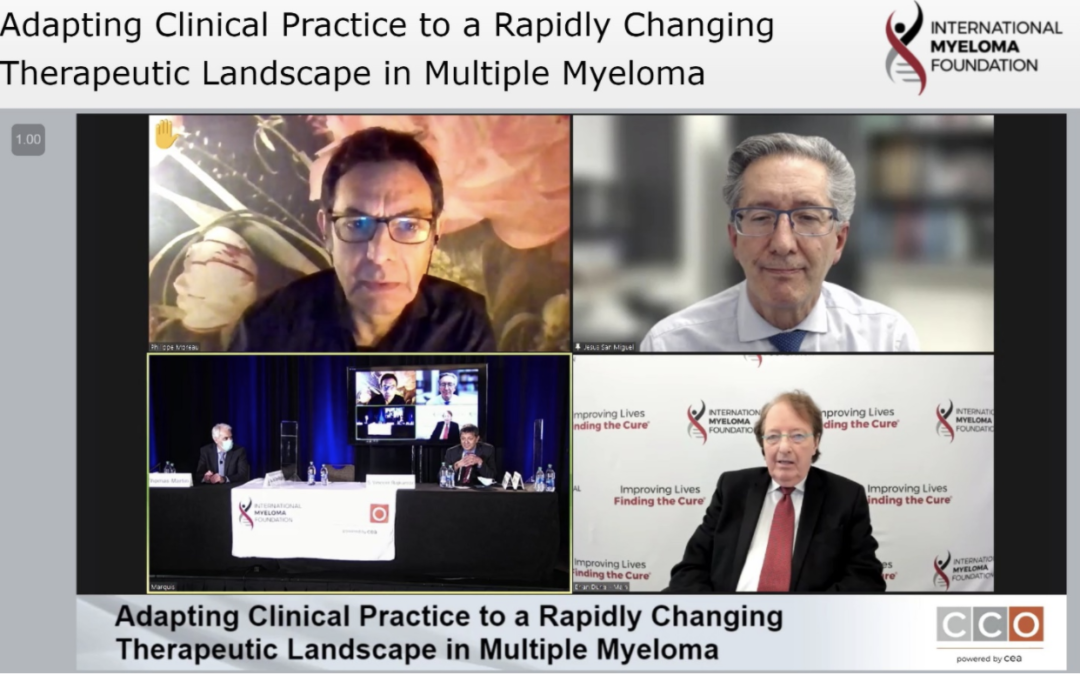
As with previous years, the International Myeloma Foundation (IMF) held its signature satellite symposium during that 63rd annual meeting of the American Society of Hematology (ASH). It featured Drs. Brian G.M. Durie (IMF Chairman of the Board), S. Vincent Rajkumar (Mayo Clinic — Rochester, MN), Tom Martin (UCSF Helen Diller Family Comprehensive Cancer Center — San Francisco, CA), Jesus San-Miguel (Clinica Universidad de Navarra — Navarra, Spain), Philippe Moreau (University Hospital — Nantes, France). Absent this year was Dr. Shaji Kumar (Mayo Clinic — Rochester, MN).
The symposium flow included a hypothetical case presentation, followed by how you treat questions and audience vote, the speakers’ case for why they voted the way they voted, and then audience polling to see if the speakers changed any audience minds.
The case studies and presentations ranged from smoldering myeloma to relapsed/refractory myeloma, approved drugs, drug combinations, and drugs in the pipeline.
I noted on the disclosure slides the only one that did not have ANY disclosures was Dr. S. Vincent Rajkumar. Does it mean the others are conflicted, and you should consider their discussions to be biased? Well, NO! I invite you to read this Twitter thread to see why not.
The significant benefit of treating high-risk SMM patients in myeloma is high, noted Dr. San-Miguel, up to 7 years of progression-free survival (PFS) before the smoldering myeloma progressed to full-blown myeloma. Not only was the progression delayed, but the risk profile post-progression was similar to those on the wait-and-watch approach. Dr. Rajkumar indicated the wait-and-watch experiment has failed for high-risk smoldering myeloma patients.
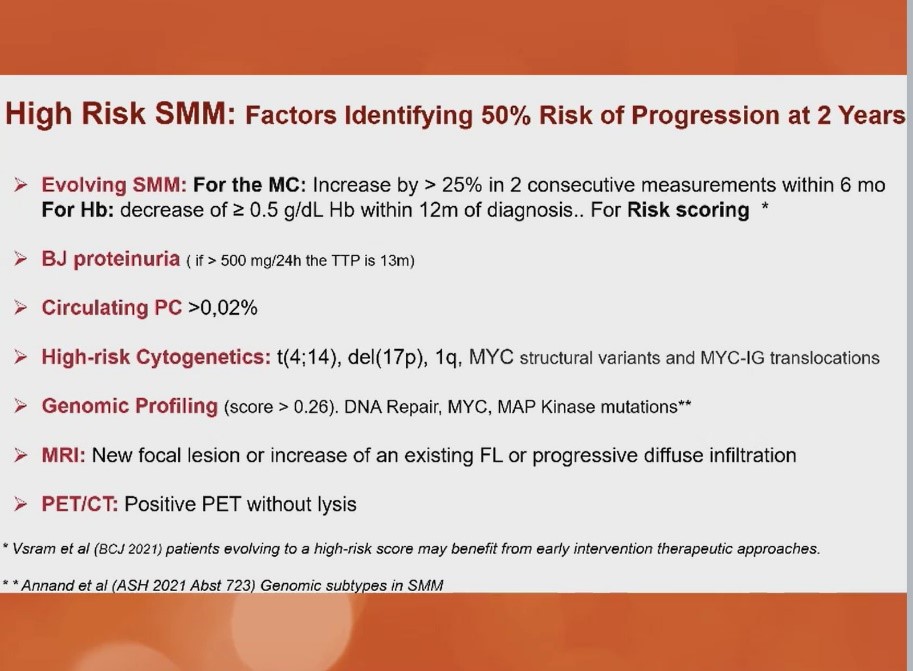
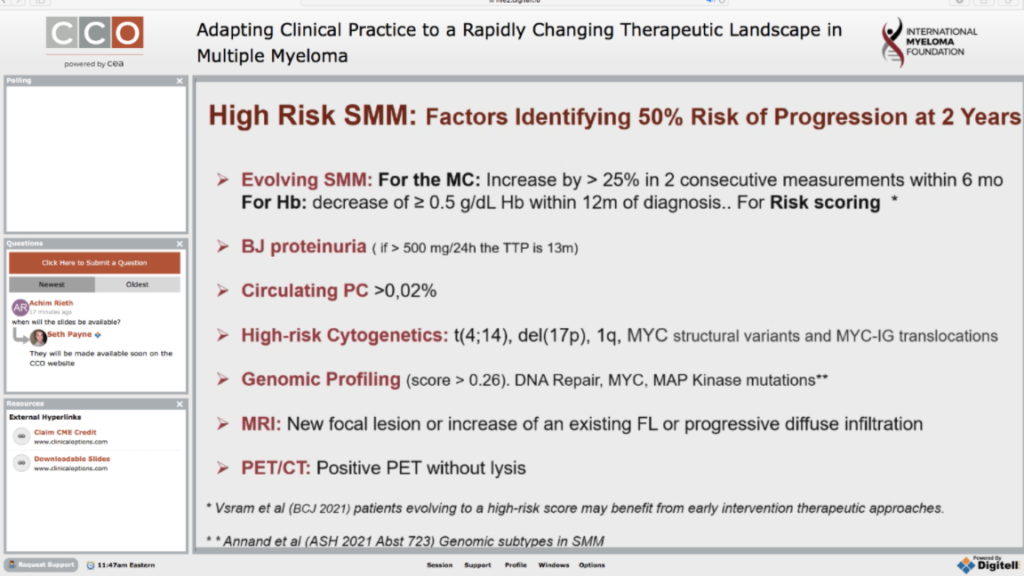
The speakers noted the features that made SMM high risk (seen below), where the presence of these features indicated an up to 50% chance of progressing to myeloma in two years.
Factors Identifying 50% Risk of Progression at 2 Years
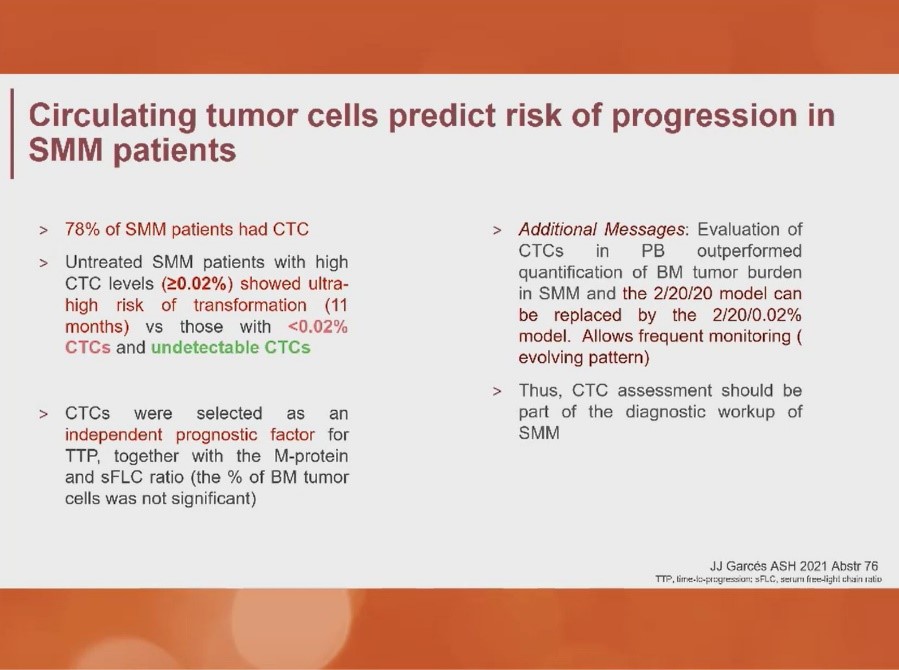
Over the last two years, the researchers consider high-risk indicators have evolved. You may have heard the 2/20/20 model. They are now indicating the potential for the model to evolve to a 2/20/0.02% model allowing for frequent monitoring of the SMM patient and early warning system that the smoldering myeloma will progress to full-blown myeloma. Watch the studies in this area as research has indicated the importance of early intervention pre CRAB.
Circulating Tumor Cells Predict Risk of Progress in SMM Patients
Some exciting questions are being asked: Can CAR T replace upfront high-dose autologous stem cell transplant (ASCT)? Dr. Morreau indicated that a clinical trial is in the design phase in Europe.
Dr. Martin’s wish list for future bispecific antibodies in relapsed/refractory myeloma included outpatient dosing with low cytokine release syndrome (CRS) and neurological toxicity, convenient administration (every 4, 6, 8 weeks). Dr. Martin had a similar wish list for BCMA CAR T cells, including faster manufacturing, better expansion, dual targeting, and outpatient administration.
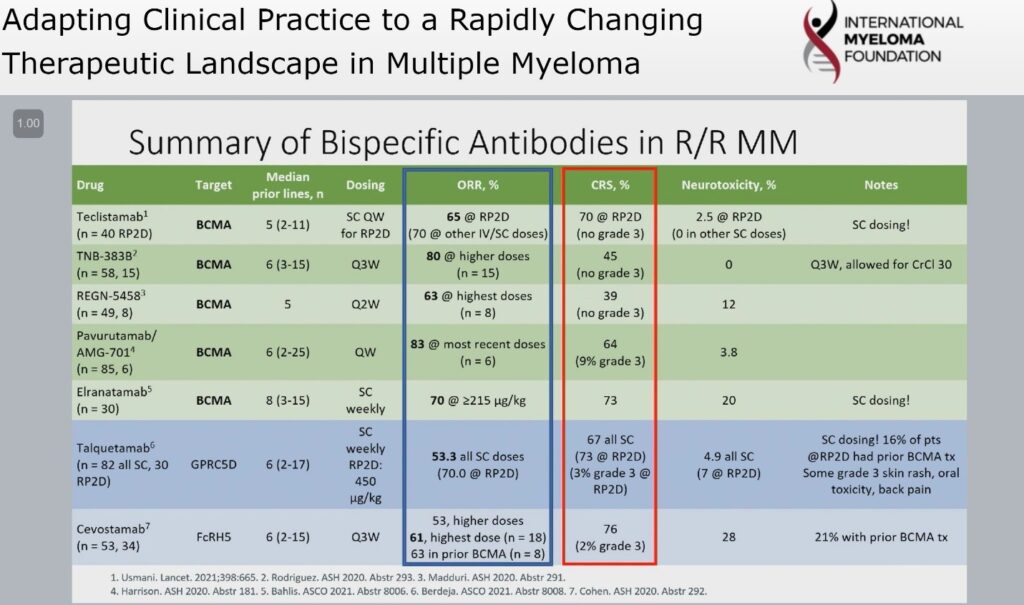
One of the highlights of the symposium was that all the bispecific antibodies for relapsed/refractory myeloma have a single drug overall response rate (ORR) of over 50%, some even 80%. This high ORR was unheard of in the chemotherapy era and even in the age of novel drugs such as Velcade® (bortezomib), Revlimid® (lenalidomide), Kyprolis® (carfilzomib), or Darzalex® (daratumumab).
Summary of Bispecific Antibodies in RRMM
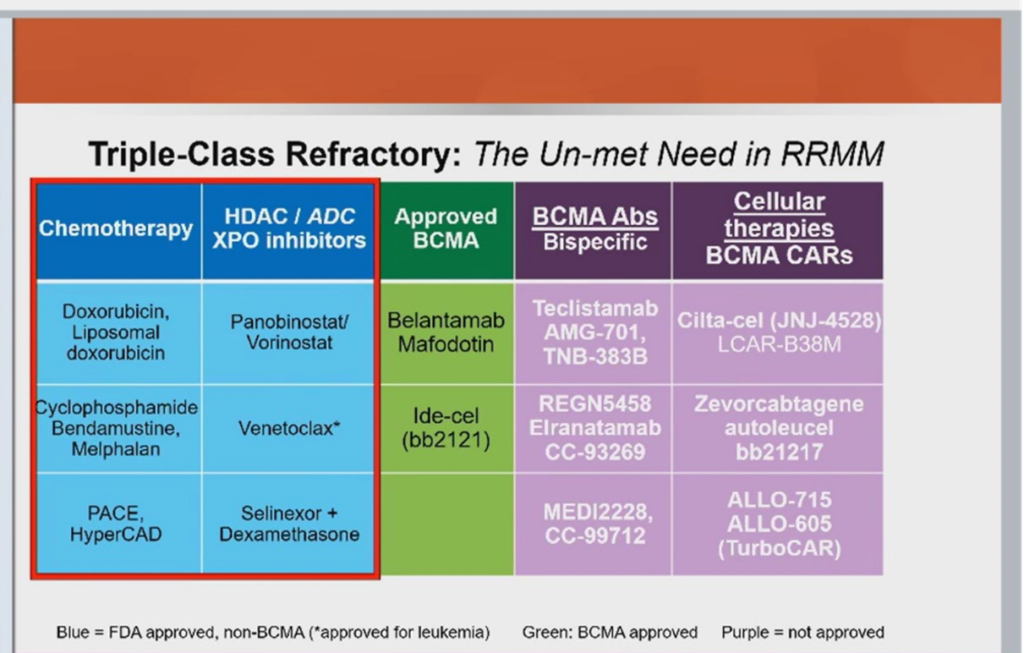
Dr. Durie discussed the unmet need of triple-class refractory myeloma patients. Those patients, despite all efforts, their myeloma continue to progress and eventually die. He indicated the issue is even more exasperated with the withdrawal of melflufen and panobinostat from the market, and the limited use of venetoclax.
The Unmet Needs of Triple Refractor Myeloma Patients
And finally, Dr. S. Vincent Rajkumar of the Mayo Clinic unveiled his “Treatment Algorithm for 2020”. This algorithm embraces the principle of triplet preference, including at least two new drugs (not sure just drugs or if feasible drug classes), consideration of transplant in patients eligible for transplant. He said, “My preference is for people not to use this algorithm and urge patients to sign up to clinical trials.”
During this symposium, I heard the phrases
Flattening of the curve (the survival curve)
Long treatment-free interval (drug holidays)
Ease of administration (at home and subcutaneous administration, treatment intervals of >2 weeks)
Fewer side effects
There was an acknowledgment by the group that more needs to be done to bridge the gap between what the on-the-ground country by country reality is and the potential these new drugs offer.
The IMF teams will be busy at ASH and will be facilitating either virtual or hybrid meetings:
The IMF CCO CME Friday Satellite Symposia is a physician educational activity that is available for those who register, either for the online virtual or in-person option.
The diagnosis of active multiple myeloma (MM) and when to initiate therapy for patients with MM continues to evolve as we learn more about the biology of this disease and how we can use various biomarkers to determine the risk of progression to active disease.
Currently, some consider beginning therapy for patients with smoldering multiple myeloma (SMM) once they have >50% risk of progression to active disease based on the 20/2/20 model. Some healthcare professionals feel uncomfortable and do not wish to start treatment for high-risk smoldering multiple myeloma (HRSMM), and ongoing monitoring happens. Today, we are hearing that we need more than the 20/2/20 model to determine treatment for HRSMM.
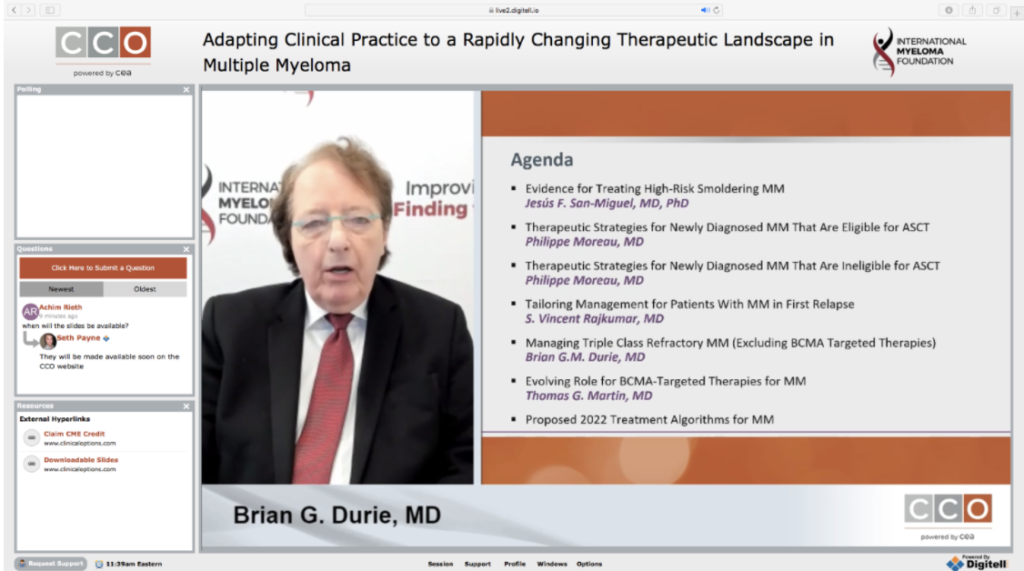
I’m sure some of the other #IMFASH21 Team Leaders will blog on other cases presented at the Symposium, but I’ll focus here on the HRSMM. Below is the excellent agenda for the IMF Symposium where 6 cases were presented, voted on, discussion ensued, voted on again.
Dr. Jesus San-Miguel (Clínica Universidad de Navarra – Pamplona, Spain) presented virtually on “Case Study 1: Evidence for Treating HRSMM.”
To Treat or Not to Treat for HRSMM:
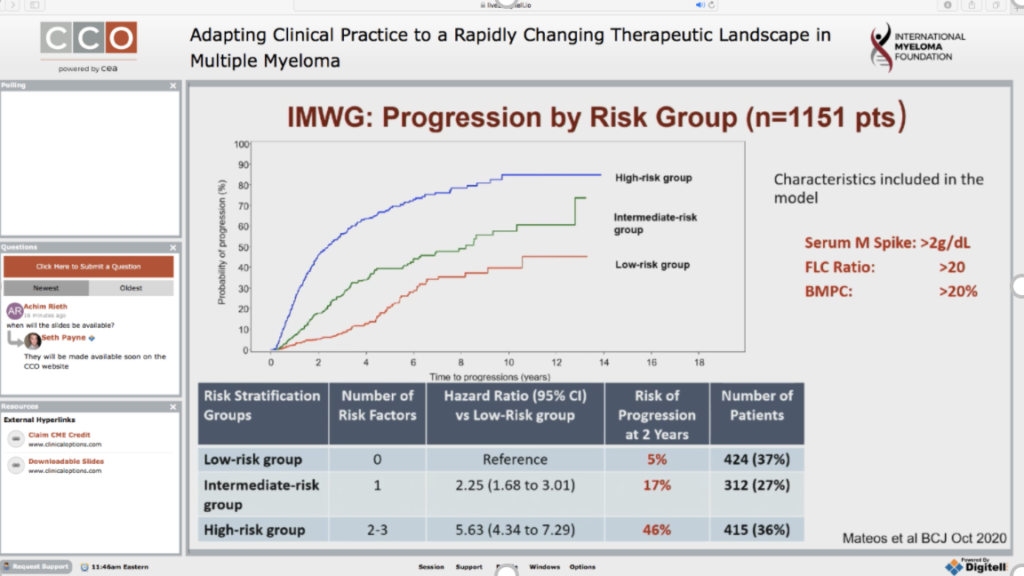
When I was diagnosed 21 years ago, there was not even a classification of HRSMM vs SMM. I remember at previous ASH when these discussions and research first started and the interest that developed. Today we have from the International Myeloma Working Group (IMWG) progression risk by group, see below:
“Having these tools helps a SMM determine to treat or not to treat – but you need more than 2/20/20!” – Dr. Jesus San-Miguel.
Today, my rock n’ roll reference song is “Treat Me Right” by Pat Benatar (1980).
What an amazing and exciting day that kicked off the 63rd American Society of Hematology (ASH) Annual Meeting and Exposition. ASH allows doctors from around the world to present various studies happening within the myeloma community. It is truly amazing to see all of the developments within this area.
In addition, I am so grateful that the meeting has a virtual component. The virtual element allows me to experience the meeting without missing a beat! If I had to attend in person, I would not be able to go. By still permitting a virtual platform, I’m able to see all the wonderful presentations that are full of the latest and greatest updates on myeloma. What a great opportunity!
Furthermore, I want to thank the IMF for this occasion. By attending ASH, I can gain more knowledge, which I can then provide to the members of the MM Families Virtual Support Group. https://www.myeloma.org/support-group/mm-families The MM Families Virtual Support group empowers myeloma patients and their caregivers who have young children. By hearing all this newfound knowledge, I hope to encourage them on their journey!
To kick off the first day of ASH, the IMF led a wonderful discussion panel which focused on the following: High-Risk Smoldering Patients; Therapeutic Strategies for Newly Diagnosed Myeloma Patients Both Eligible for Transplant and Not Eligible for Transplant; Tailoring Therapies for First Relapse; Managing Triple-Class Refractory Myeloma, and BCMA-Targeted Therapies.
It was so interesting to hear all the discussions and studies on these various topics. One of the most interesting items that I learned was the development in treating high-risk smoldering multiple myeloma (SMM). Wow! How times have changed! While there is still debate on whether to treat SMM or take the “watch and wait” approach, some of the new studies showed so much promise in treating myeloma early. There was also some interesting data on high-risk patients and tandem transplants, as well as discussion between triplet and quadruplet therapies. In addition, there are so many interesting new studies relating to CAR T.






You must be logged in to post a comment.