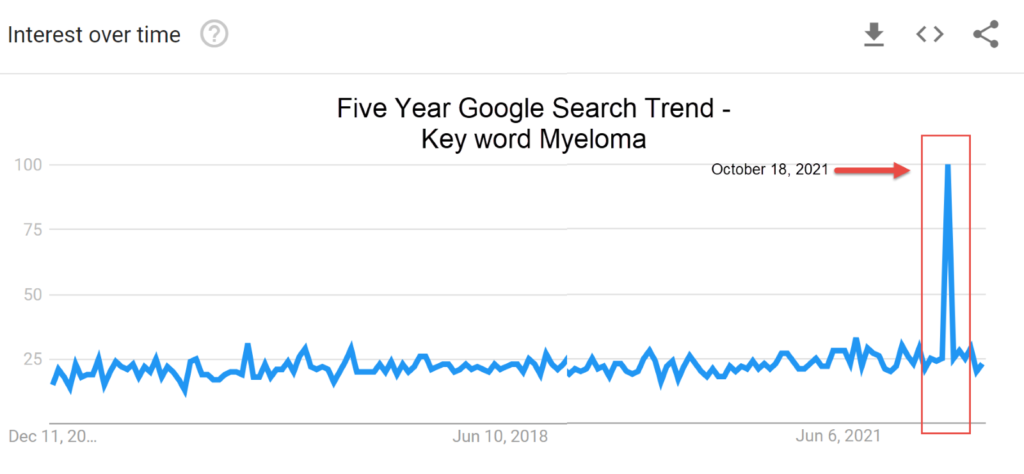
On December 12, 2021, there were 545 open and recruiting clinical trials on the clinicaltrials.gov website. There are over 800 #ASH21 abstracts with the word #myeloma in them. There was a four-fold increase in Google’s keyword trend for #myeloma after the death of Secretary of State General Colin L. Powell. Over 750,000 men, women, and children have died in the US and over 5 million worldwide due to the #COVID19 pandemic. Delta and Omicron COVID variants continue to humble and teach us that collaboration is key to overcoming.
Google Keyword Search Trend for Myeloma
The FDA approved the first BCMA-targeted CAR T-cell therapy for multiple myeloma, Abecma® (idecabtagene vicleucel). The hopeful approval for the second CAR T, cilta-cel, had been delayed by three months but is expected in Q1 of 2022.
This year’s ASH will highlight the progress of several critical research:
MGUS and SMM – Is screening the way to go? What is the psychological impact of “knowing early?” Are African Americans at a higher risk for MGUS and as a result, myeloma? What is the effect of high-dose treatment for SMM patients?
MRD-guided therapy – Can we use MRD to pause treatment? What is the impact of quadruplets on MRD?
CAR T, BCMA therapies – What are the outcomes of phase 1/2 or 2/3 studies for CAR T and BCMA, such as teclistamab, and others that don’t even have a name yet? How about off-the-shelf CAR Ts to alleviate collection and production issues of CAR Ts?
Maintenance – Is maintenance the way to go? Which single or double is best for maintenance? How about QOL, affordability, and impact on subsequent therapies?
The IMF teams will be busy at ASH and will be facilitating either virtual or hybrid meetings:
The Friday IMF Satellite Symposium
International Myeloma Working Group (IMWG) Breakfast
IMWG Conference Series
Global Myeloma Action Network (GMAN) Summit
Best of ASH Conference
The IMF SGLs will be attending ASH virtually, so we won’t have that awkward moment of fist-bumping while someone else is extending a handshake!
Wow! I’m continually amazed by all top-notch doctors and researchers who focus on finding new and better approaches to deal with myeloma – whether in the active multiple myeloma space or the smoldering multiple myeloma space. As I was thrust (unceremoniously, I should add) into the world of myeloma five years ago, I’ve learned about the astonishing advances in myeloma treatment in recent years.
This year, I’m thrilled to be able to play a part in sharing latest research findings. I will be attending the 63rd American Society of Hematology (ASH) Annual Meeting virtually, as part of the International Myeloma Foundation’s patient advocacy team.
My focus at ASH will be in the smoldering multiple myeloma (SMM) space, where so much research has been happening in recent years. We’ve seen changes in the criteria used to determine progression (i.e., SLiM CRAB), as well as new indicators that help predict risk of progression (i.e., 2/20/20).
Those who were considered as high-risk now have treatment options, often but not necessarily with a trial that didn’t exist 5-10 years ago. Naturally, questions about when to start treatment and what treatments ought to be considered will arise.
As these questions are batted about by experts, I’m delighted to have the opportunity to bring a patient’s perspective and share with you the focus of the latest research along with what the researchers are finding.
A brief search of the 2021 ASH abstracts using “smoldering myeloma” as the keyword resulted in 50+ different sessions. Looking through these abstracts, I organized them, from my non-medical lay perspective, into five (5) categories. I’ve also included a selected presentation title from each category to give you an idea of the research that will be presented:
There are also a handful of what I labeled “educational program sessions,” where smoldering myeloma is included within a session. One example is What’s New in Plasma Cell Disorders? I imagine these educational sessions are designed to highlight the latest research findings and to help bridge the research-to-practice gap for practitioners, but I’m not positive about that. Some also seem to focus in looking to the future, using current findings to help predict where myeloma treatment may be headed.
The research happening in this space is important and valuable to those with SMM. To me, it provides a sense of hope and optimism — two things that can sometimes be in short supply when dealing with the gray area of SMM.
While the standard of care for those diagnosed with SMM has been “watch and wait,” I can’t wait to listen, learn, connect with my IMF teammates, maybe interact with physician researchers (one can hope!), and also share the latest findings with you.
I will do my best, I promise. It is the least I can do. I am continually amazed and humbled by those who have committed so much time, energy, and expertise to advancing our understanding and knowledge of myeloma. Onward to ASH (virtually, of course)!




You must be logged in to post a comment.