“When you arise in the morning think of what a privilege it is to be alive, to think, to enjoy, to love…” —Marcus Aurelius, Meditations
This year at the Annual Meeting of the American Society of Hematology (ASH), there have certainly been challenges with technology, whilst holding an in-person meeting and a virtual meeting at the same time. There are presenters and moderators attending virtually from all over the world. This can be stressful for those watching, as well as the technical team, who are behind the scenes.
On Saturday morning, we had one of those technical issues which prevented us from hearing a presentation. While waiting for the issue to be resolved, I found my way (virtually) to the ASH Wellness Studio to look for a relaxation or meditation program. I was very excited about what I found.
Dr. Kulvi Kaur presented a fascinating program about how stress affects gene expression associated with inflammation and longevity. Meditating 15 minutes a day increases the expression of genes associated with longevity and reduces the expression of genes associated with inflammation.
Dr. Kaur also presented a program on how a regular yoga/meditation practice can improve longevity and prevent cognitive decline. I found this fascinating, especially since I struggle with “chemo brain.” One of the suggestions was to practice Kirtan Kriya — a meditation technique of chanting and finger movements. Try it for yourself.
Another simple method to relax and improve your mind is breathing. It’s free and powerful and easy. We do it every day, automatically, without thinking. But if we take a few minutes of our day to concentrate on our breath, it is a great self-help tool. Here is one method: Inhale through the nose for a count of 4, then exhale through the nose for a count of 6-8. Repeat this pattern for a couple of minutes.
“The chronic stress that is associated with shallow breathing results in lower amounts of lymphocyte, a type of white blood cell that helps defend the body from invading organisms, and lowers the amounts of proteins that signal other immune cells. The body is then susceptible to contracting acute illnesses, aggravating pre-existing medical conditions and pro-longing healing times.” — John Luckovitch, Integrative Breathwork Facilitator
ASH ‘s annual meeting is filled with updates on clinical trials and research on ways to treat multiple myeloma. These doctors and researchers work so hard to find the best ways to treat and possibly cure myeloma.
The ASH Wellness Studio addresses the need for self-care among these attendees. This information can also be used by patients to help our bodies and minds cope with the challenges of being a multiple myeloma patient.
December 12, 2021 – Today began with watching a few presentations that focused on the epidemiology of myeloma patients. For example, abstract 400 examined COVID-19 vaccine effectiveness for multiple myeloma (MM) patients associated with the VA. They examined nearly 7,000 MM patients and compared COVID-19 results with vaccinated and unvaccinated patients, as well as compared these with non-MM patients. Not surprisingly, they concluded that vaccines were an effective strategy for preventing COVID-19, but less so for MM patients.
Abstract 402 examined racial and ethnic differences in MM patients. The presenter, Dr. Nancy Gillis (Moffitt Cancer Center – Florida) remarked that “Blacks are getting one-half the benefit of improved survival outcomes compared with whites. However, similar access to care results in similar outcomes.” As a society, we need to do more to accrue a diverse population in our clinical trials and then provide better access to new treatments.
I always appreciate it when negative trial results are presented. These are trials where the suspected benefit hypothesis is not met. Abstract 466 compared Ninlaro® (ixazomib) added to Revlimid® (lenalidomide) + dexamethasone (IRd) maintenance versus (Rd) alone and concluded that the Ixa arm did not result in improved progression free survival (PFS). And abstract 486 concluded that the addition of Empliciti® (elotuzumab) to Revlimid, Velcade® (bortezomib), and dex (ERVd) induction/consolidation and Rev maintenance did not result in improved PFS or overall survival (OS).
Other abstracts showed the benefit of adding either Darzalex® (daratumumab) or Sarclisa® (isatuximab) (both CD-38 monoclonal antibodies) provides benefit when considering outcomes such as responses, minimal residual disease (MRD) rates, PFS, and or OS. Example include Abstracts 463 (Isa + RVd induction), 464 (dara + IxRd induction), and 465 (dara + CyBorD + Rev (5 drugs!) for ultra high-risk MM).
Another important study, Abstract 467 examined the impact of chromosome 1 gain (3 copies), amplification (>3 copies) and deletion, conferring inferior PFS compared with standard risk patients. Kyprolis® (carfilzomib), Revlimid, and dex (KRd) may overcome negative OS for gain1 and del1 but not necessarily amp1, however more follow-up needs to be done for this particular mutation.
And speaking of chromosomes, 17p deletion is long-considered to be a high-risk factor. But how is the clone size (17del seen in >60% plasma cells) impacted by a tandem transplant? Abstract 460 demonstrated tandem transplant compared with a single transplant improves outcomes but clone >60% may negatively impact outcomes. However, there were a couple of audience questions about biased results, such as tandem patients being more fit than single transplant patients.
I want to now share what I consider today’s most impactful presentations. All of the CAR T’s presented below have an additional focus of lengthening the persistence (survival) of the CAR T cells in order to increase PFS times.
CAR’s and more
CT103A CAR T from China demonstrated (N=79) 95% ORR with 58% CR with mPFS of 25 months. The first enrolled patient is still in stringent complete remission (sCR) for 34 months. And for 13 patients who had previous CAR T, ORR was 77% and CR 39%. [547]
bb21217 CAR T for N=72 included 40% HR and 22% EMD patients. Results include 69% ORR (inc 28% CR) and mDOR of 2 yrs. [548]
CARTITUDE CAR T updated results after 2 yrs follow-up for N=97. ORR 98%, CR 83%; 2-yr PFS and OS were 61% and 74% respectively and even higher for those with sustained MRD-. [549]
ARI0002h CAR T appears unique because some of a patient’s CAR T cells are given up front and then a booster dose is subsequently given. For N=30, ORR=100 and CR=60% and the mPFS is estimated to be 18 months.
Master Trial: Dara-KRd -> SCT -> D-KRd -> D-KRd -> R maintenance. MRD is tested after each treatment and 2 successive MRD- at 10-5 results moves the patient into a MRD-SURE category to stop treatment (observation only) with continued MRD surveillance. Results were presented for SR, HR and UltraHR (>1 HR factor) patients. 2-yr PFS and OS were in the 90%+ for SR and HR but only 58% and 76% respectively for UHR pts. And 84 pts (72%) achieve MRD-SURE. [481]
In abstract 551, an oral Gamma Secretase Inhibitor to increase BCMA expression may be used in the future with BCMA-directed therapies.
That’s it for today. Tomorrow’s sessions include IMWG Conference Series from ASH 2021. IMF Chairman Dr. Brian G.M. Durie, Dr. Maria V. Mateos (University of Salamanca — Salamanca, Spain), Dr. Thomas Martin (UCSF Helen Diller Family Comprehensive Cancer Center — San Francisco, CA) and MM Nurse extraordinaire Beth Faiman PhD, RN, MSN, APRN-BC, AOCN (Cleveland Clinic Taussig Cancer Institute — Cleveland, Ohio) distill, debate, and discuss the latest news and trends in the treatment of multiple myeloma from this 63rd Annual ASH Meeting. Check out the IMF website for replays.
During yesterday’s blog, I focused much on details of studies, trying to absorb as much of the scientific data as possible. As a nurse who hasn’t had formal training on data collection and research, it can be very easy to get lost in that data. I found myself feeling like I was in the middle of a tornado, spinning around in circles, and grabbing ahold of whatever I could, information-wise.
ASH is intense! 879 Abstracts at ASH 2021 focused on multiple myeloma — that’s a TON of information to soak in in 4 days! I decided to take a step back and refocus on my goal. I took advantage of some of the mindfulness exhibits available to try to calm the storm! This storm is not a negative one, I want to be clear on that. The information storm that I speak of is simply a lot of information in a short time. I do appreciate the ability to view the abstracts for the rest of the month and absorb more information, including details, from each one.
My personal goal for attending ASH this year was to be able to communicate information from the research back to my support group members and their care partners. It seemed like a simple goal when I made it, but when given this amount of information, it is so easy to get stuck in the weeds about what parts to report on, what details are important.
What is REAL LIFE info that patients will benefit from? I have to admit, sitting in front of my laptop for 10 hours straight, feverishly taking notes, snapping screenshots, looking up keywords, making outlines, and trying not to miss a word of this important information being shared was OVERWHELMING! I started to reevaluate my strategy for moving through the rest of the conference, and to be real with myself! I’m not going to catch every word or understand every definition or statistic. I’m not going to remember all the data and be able to recite it word for word. That’s not realistic, nor attainable!
My major takeaways from Sunday’s oral and poster presentations:
• I appreciate, more than words can say, myeloma specialists who can present incredibly technical information in a way that is understandable! Drs. Luciano Costa (O’Neal Comprehensive Cancer Cen ter University of Alabama — Birmingham, AL) and Thomas Martin (UCSF Helen Diller Family Comprehensive Cancer Center — San Francisco, CA) are two of the best! Truly personable, funny, and down-to-earth enough to be able to simplify some incredibly difficult information! Thank you, from patients and nurses alike!
• It is important to acknowledge the financial disparities between the US and the rest of the world when it comes to drug costs and availability. We have to do better so that patients can have access to proven therapies.
• Ciltacabtagene autoleuce (cilta-cel) is EXCITING! Updates to 24-month progression free survival and overall survival data were presented and look incredibly positive. With an updated Prescription Drug User Fee Act (PDUFA) date in February 2022, there is much anticipation for this therapy for at least triple refractory patients. Hopeful that the manufacturing slot availability will be able to support the almost assured demand!
• I overheard a comment made when discussing the diversity profile of a study group of a particular clinical trial that stated that the 17% African American participation in this trial was “impressive and encouraging.” This makes me sad when less than 1/5 of the study population being minority is encouraging! We need to do better with recruiting more minority subjects into myeloma clinical trials. With a disease that clearly has a great impact on the African American population, we need to do better getting an appropriately diverse study selection when researching and learning more about it!
Share Hope. Education is Power. Stay excited and motivated for the future!
The last few years, I have been interested and hopeful in the number of types of immune therapies. Immunotherapies aid our own immune systems to help fight infections and attack cancer cells. We want our immune systems to function as normally as possible to find and destroy abnormal cells to possibly prevent or slow the growth of many cancers, including myeloma.
However, we all know that myeloma is smart and tricky. Myeloma cells have ways to avoid the immune system’s ability to destroy them due to genetic changes that make myeloma cells less visible to the immune system.
Dr. Mikhael has created a series of videos to help us better understand:
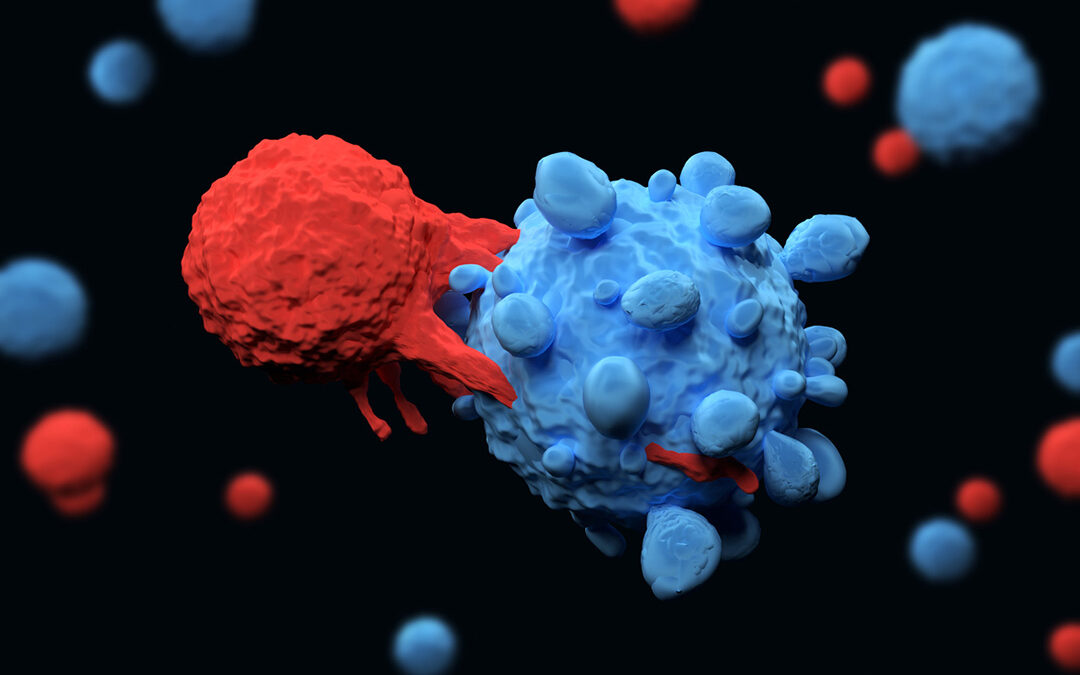
Harnessing the power of our own immune systems to work best and help it to do what it’s supposed to do is smart science! Bispecifics act as the bridge connecting the T-cells to the myeloma cell. The T-cell then kills the myeloma cell, as it recognizes it as an abnormal cell. These bispecifics are what are sometimes referred to as “off-the-shelf.” This is different than the CAR T immune therapies, whereby a patient’s own T-cells are harvested and then sent to a lab to be re-engineered and then given back to the patient.
This process takes time and the challenge of what does a patient do while waiting for treatment, plus can a patient even get CAR T? We have heard that cancer centers only have a certain number of spots for patients waiting for CAR T. Hopefully, this shortage of spots opens soon to enable more myeloma patients to have access to CAR T.
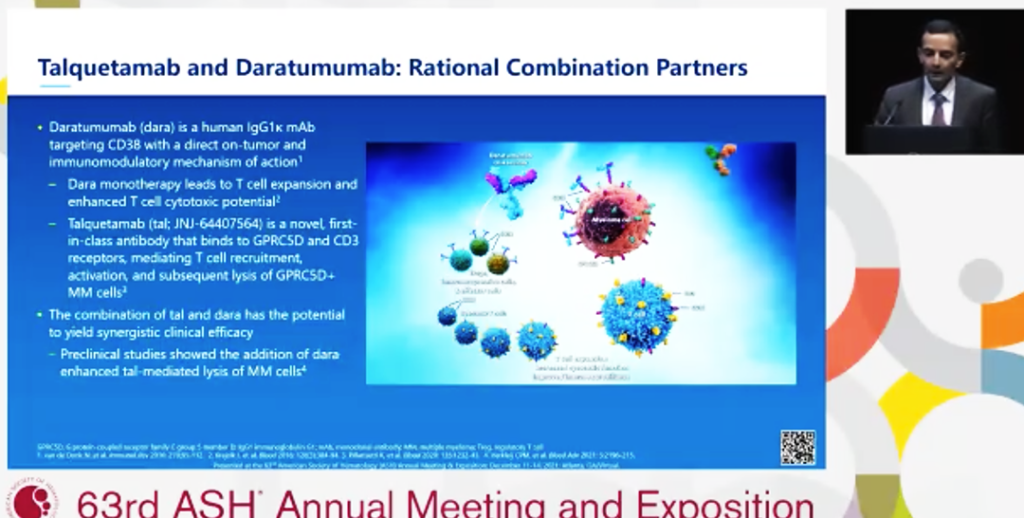
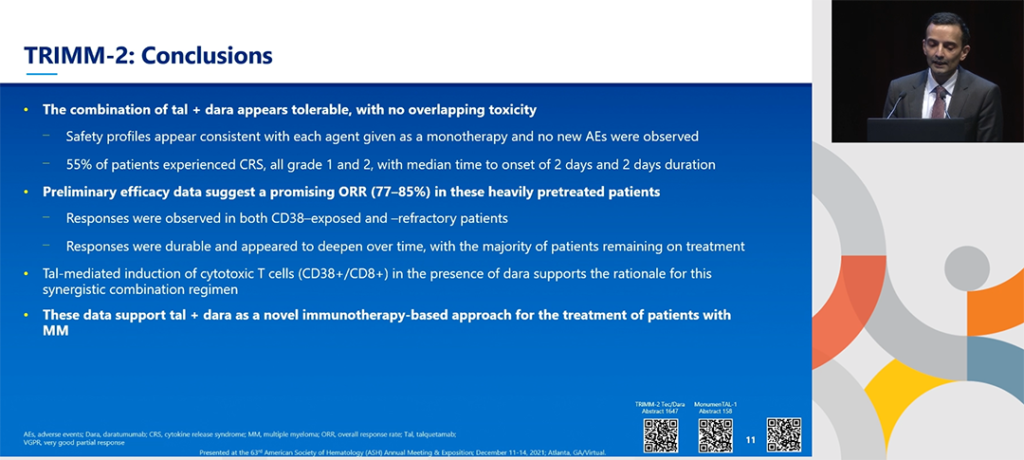
On Saturday afternoon, we listened to Abstract 161 on “Phase 1b Results for SubQ Talquetamab Plus Daratumumab in Patients with Relapsed/Refractory Multiple Myeloma (RRMM)” by Dr. Ajai Chari (Mount Sinai — New York). This bispecific is a little different because instead of targeting B-cell maturation antigen(BCMA), it targets G protein-coupled receptor, class C group 5 member D (GPR5CD). This is important for patients who have already had multiple BCMA targeted therapies, because it’s a different target to go after besides BCMA. More Targets = More Hope!
Here are a few slides on SubQ talquetamab plus dara:
The title of today’s blog is “I Hope Myeloma BiTES the Dust” and here’s my song for you to enjoy by Queen:
Day 3 of ASH was another whirlwind of talks, and even for this scientist, all the details were beginning to blur together. I heard talks that ranged in focus (1) from understanding the molecular basis of disease; (2) to delineating the role of precursor conditions in myeloma progression; (3) to developing the best diagnostic approaches to track disease; (4) to analyzing clinical trial outcomes in order to measure therapy effectiveness. Throughout the day, I found myself noticing a common theme in these very differently focused talks.
The role of the myeloma patient was very central to all of the talks I attended, whether it was (1) using blood or bone marrow samples from myeloma patients in research; (2) deciding when it makes the most sense to start treatment; (3) pondering whether technologies that measure MRD-negativity would allow patients to stop treatment for a time; or (4) thanking the many patients who participated in clinical trials. Every talk had myeloma patients front and center.
As a patient myself, this perspective brings so much hope, knowing that the research is driven by motivation to help patients like me. It makes me realize that myeloma researchers and clinicians are truly motivated by a desire to improve the quality of life for myeloma patients.
Indeed, the International Myeloma Foundation, who brought me to this conference as a patient advocate, has the phrase, “We’re Here for You!” front and center on their website home page, and I felt that community of support throughout this meeting.
I was also very pleased to learn that #ASH21 has both an Antiracism Studio and a Wellness Studio to help their attendees grow as people. I spent some time exploring both of these studios over the past couple of days. A session on Effectively Engaging Community in Science and Research was a good reminder that, while there has been progress, we still have work to do to ensure that all myeloma patients have access to the best care and clinical trials.
It was good to see several scientific presentations that discussed the inclusion of patients with diverse racial and ethnic backgrounds or patients who were older and frailer. There was also a focus in the scientific questions and answers on the gaps that still needed filling in this area. A session called Ten Minutes to Resilience listed the following critical eight steps: (1) accept change, (2) learn continuously, (3) take charge, (4) define purpose, (5) create balance, (6) cultivate love, (7) reflect, and (8) reframe skills.
Resilience is important for researchers, providers and patients when tackling a challenging disease like multiple myeloma. Our central MA multiple myeloma support group has focused on resilience throughout the pandemic, starting each meeting with a check-in question that focuses on a way we can build resilience. I am so excited to bring back all that I’ve been learning to our group so we can continue to build our resilience as we learn how to manage multiple myeloma together. When we are there for each other, it makes all the difference!




You must be logged in to post a comment.