We are in the week leading up to a major annual international conference, the American Society Hematology (ASH). During this meeting, bench and clinical myeloma research from all over the world will be presented and discussed.
I am excited, humbled, and fearful at the same time. I am humbled at this tremendous opportunity afforded to me by the IMF. I would love to see and hear everything over the 4 official days of the meeting, but that would be impossible. I heard that there are over 600 people who will share their research on multiple myeloma. I’m studying the agenda and trying to decide when and where to go, and whom to hear. It’s all virtual, so it should be easier, but not for me. There are so many wonderful and different choices!
Have you ever heard the phrase, “from bench to bedside?” It’s all about taking laboratory research from the laboratory to hospitals and clinics. The more important phrase for me is: “from bench to bedside to curbside.” I will spend more of my time in the translational research area, where the research reaches the “end-user” – the patient in the community…at home… at the curbside.
Of course, I am eager to hear about the new scientific advances in myeloma. I am also interested in what scientists have to say about health equity – or if, in the post- George Floyd era, if there is any mention of racism in medicine and how that might impact effectiveness of the delivery of vital research.
Is the best science available to everyone? This is a question raised by some who might hesitate to participate in the clinical trials. Will the best of the research be available to everyone in an equitable way – regardless of age, race/ethnicity, gender, or income level? These are some of the thoughts that will take me into the preparation and the first days of this incredible experience.
Welcome to ASH 2021. This year, it’s hybrid-style! ASH is monitoring the recent discovery of the Omicron variant and is proceeding with a hybrid meeting to include both in-person and virtual options.
I’m grateful to the IMF for deciding months ago that the patients/support group leaders who will be attending #ASH21 will be participating virtually with us. While I will miss connecting with everyone and the excitement brought about by in-person meetings, patient health & safety is always top priority.
Fortunately, we will still be able to attend all oral and poster presentations virtually; we will be reporting to you through blogs and tweets. Please follow all the leaders on this page and search for these hashtags: #ASH21, #IMFASH21, #myeloma #mmsm
My husband Michael and I have had the opportunity to travel with Dr. Brian G. M. Durie and Susie Durie to Iceland in 2018 and 2019 to hear the research updates from the iStopMM team (Iceland Screens, Treats, or Prevents Multiple Myeloma). This is the first large-scale screening study aimed at preventing myeloma before it develops. The first results of the iStopMM screening study were published in May 2021.
There will be four iStopMM oral presentations and an additional two abstracts presented as posters at #ASH21. Dr. Durie outlined them in his recent blog which you can read here.
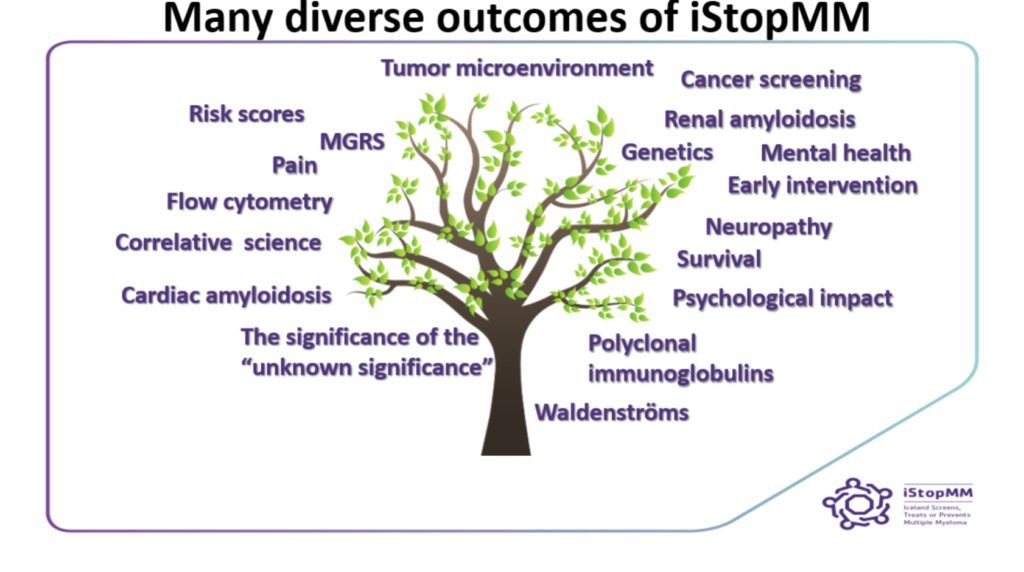
When we were at the iStopMM meetings in Iceland, Dr. Sigurdur Kristinsson and Dr. Saemundur Rognvaldsson presented an early version of the Tree below. The branches of this iStopMM Tree have certainly grown and as you can see, there are many diverse outcomes. I’ll try to incorporate one or two of these branches in each of my blogs.
Today, I will go over two branches from the Tree that Dr. Rognvaldsson shared with me:
Cancer screening – The iStopMM project is a population-based screening where blood samples are collected in a pragmatic and large-scale way. The iStopMM method of collecting samples passively for screening can become a model of cancer screening in the future, especially with the advent of new blood sample-based cancer screening methods.
Genetics – The iStopMM team is collaborating with deCODE genetics to do a deep analysis of the genetics of tumor cells and the genetics of people who have MM and its precursors. This can help us understand why genes and genetic mutations lead to the development of myeloma. Unique to iStopMM, repeated sampling and follow-up over time will allow us to watch these genetic changes happen from our germline genetical makeup (normal genetic makeup at birth) to the mutations leading to MGUS and then to the development of active myeloma. By understanding this timeline, we will be able to open new avenues in treating and preventing myeloma.
In closing, I will leave you with a calendar of IMF ASH links. Make sure to tune in next week as much as possible:
Friday, December 10
IMF ASH Satellite Symposium: “Adapting Clinical Practice to a Rapidly Changing Therapeutic Landscape in Multiple Myeloma”
Years 2020 and 2021 were certainly filled with both unexpected challenges and silver linings for the entire world. I prefer to focus on the positive and when I think about time, I think of how lucky I am to be here. I was diagnosed in September 2000 so I am now a 21-year survivor, or should I say a Myeloma Warrior? It hasn’t always been easy, but with the milestones I’ve reached with my family and the research I’ve benefited from, living with myeloma has kept me grounded, humble, and grateful.
In 2000, I was 36 and our children were 2 and 7 years old. Back then, treatment options were extremely limited. We were told to be prepared and to write our will. Today, we have an armamentarium of options. Each one comes with great hope for longer remissions, fewer side effects, and a better quality of life.
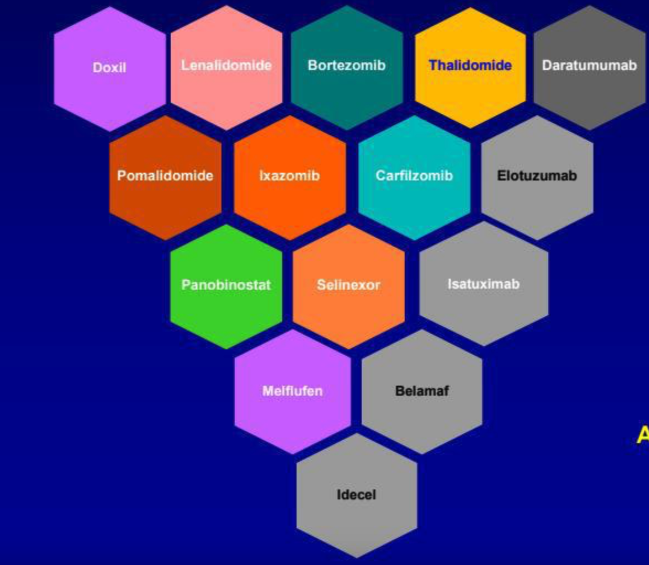
There are multiple novel agents that are now available to treat newly diagnosed and relapsed/refractory myeloma. Depending on how you count the treatments and combinations, there are currently 15 FDA-approved treatments for myeloma with more coming!
The question that I will be focusing on at ASH: How do we sequence and strategize therapies to ensure the best outcomes? It’s certainly a hopeful time.
If you have read my blogs from previous ASH reports, you probably noticed that because of my love for music, I’ve made it a tradition to include rock songs in my blogs.
Songwriter and former member of The Band, Robbie Robertson recently did a remake of the song “The Wait” with musicians from all over the world. Indeed, music has the power to break down boundaries and to bridge the distance between people.
We are seeing global research and collaboration come together at ASH.
“It Makes No Difference” from The Last Waltz by The Band takes on a special meaning, as we “wait” for better treatments and a cure. It’s a sad song with threads of hope coming from Garth Hudson’s masterful saxophone-playing, Robbie Robertson’s lead guitars, and from the heart-wrenching vocals of Rich Danko.
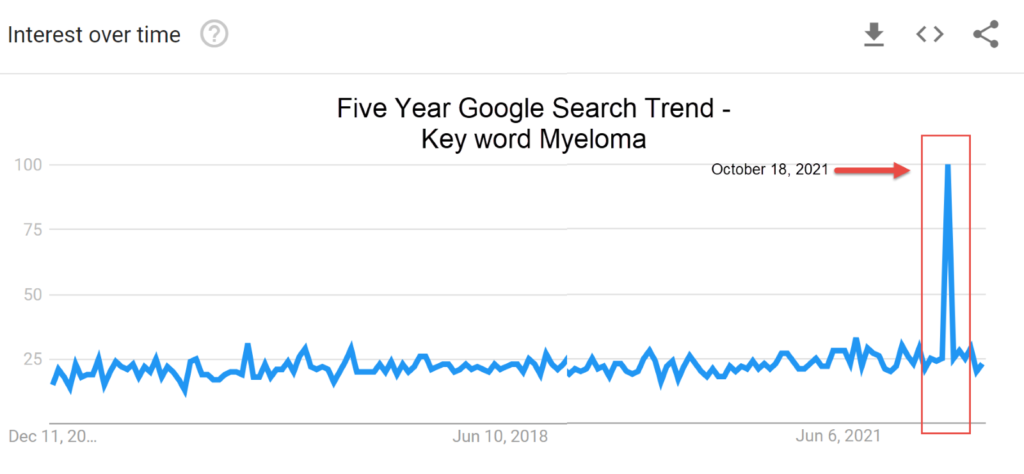
On December 12, 2021, there were 545 open and recruiting clinical trials on the clinicaltrials.gov website. There are over 800 #ASH21 abstracts with the word #myeloma in them. There was a four-fold increase in Google’s keyword trend for #myeloma after the death of Secretary of State General Colin L. Powell. Over 750,000 men, women, and children have died in the US and over 5 million worldwide due to the #COVID19 pandemic. Delta and Omicron COVID variants continue to humble and teach us that collaboration is key to overcoming.
Google Keyword Search Trend for Myeloma
The FDA approved the first BCMA-targeted CAR T-cell therapy for multiple myeloma, Abecma® (idecabtagene vicleucel). The hopeful approval for the second CAR T, cilta-cel, had been delayed by three months but is expected in Q1 of 2022.
This year’s ASH will highlight the progress of several critical research:
MGUS and SMM – Is screening the way to go? What is the psychological impact of “knowing early?” Are African Americans at a higher risk for MGUS and as a result, myeloma? What is the effect of high-dose treatment for SMM patients?
MRD-guided therapy – Can we use MRD to pause treatment? What is the impact of quadruplets on MRD?
CAR T, BCMA therapies – What are the outcomes of phase 1/2 or 2/3 studies for CAR T and BCMA, such as teclistamab, and others that don’t even have a name yet? How about off-the-shelf CAR Ts to alleviate collection and production issues of CAR Ts?
Maintenance – Is maintenance the way to go? Which single or double is best for maintenance? How about QOL, affordability, and impact on subsequent therapies?
The IMF teams will be busy at ASH and will be facilitating either virtual or hybrid meetings:
The Friday IMF Satellite Symposium
International Myeloma Working Group (IMWG) Breakfast
IMWG Conference Series
Global Myeloma Action Network (GMAN) Summit
Best of ASH Conference
The IMF SGLs will be attending ASH virtually, so we won’t have that awkward moment of fist-bumping while someone else is extending a handshake!
Hey, all. Thanks for reading my blog. I am excited to join the International Myeloma Foundation’s (IMF) “Support Group Leaders (SGL) go to ASH” program and share updates from the meeting. I have lost track of how many years I have been attending with the IMF, but it has been more than 9 years, based on my Twitter anniversary.
The 63rd American Society of Hematology (ASH) annual meeting will be held in Atlanta, GA from December 11 – 14, 2021, offering virtual attendance. The SGLs will attend virtually to reduce the risk of COVID-19 exposure. I’m very pleased with this approach, as I’m a big fan of safety, and “live tweeting” is easier from my desktop rather than my laptop.
We have all experienced a lot of changes in the past two years, as we live “through” a pandemic, or more accurately, live “within” a pandemic.
For some, you may have received your multiple myeloma diagnosis during this time, adding to the uncertainty of the times. Others may have had to delay or interrupt treatment as a result of the medical shortages and concern for infection.
For myself, it helped bring some things into focus. For the first 30 years of my career as an oncology nurse at Mayo Clinic-Rochester, I loved working in the area of blood and marrow transplant (BMT), working with all transplant-indicated hematologic disorders.
Multiple myeloma is the number one indication for autologous stem cell transplant, hence, my 15-year focus on this disease as a member of the IMF’s Nurse Leadership Board (NLB). Through all these years, I embraced the Mayo philosophy: “The needs of the patient come first”.
My volunteer activities as an SGL and working with the amazing members of the IMF NLB have added focus to patient empowerment through education.
In 2021, as I entered my 31st year as an oncology nurse, I made the transition from BMT Nurse Coordinator to the development of a new role, as a Myeloma Nurse Navigator. The vision of this role is three-fold: to create increased awareness of clinical trial participation; to empower patients through education; and to assist providers to enhance clinical efficiency, allowing for more focused time with the patient. Talk about the perfect role to meld my passions.
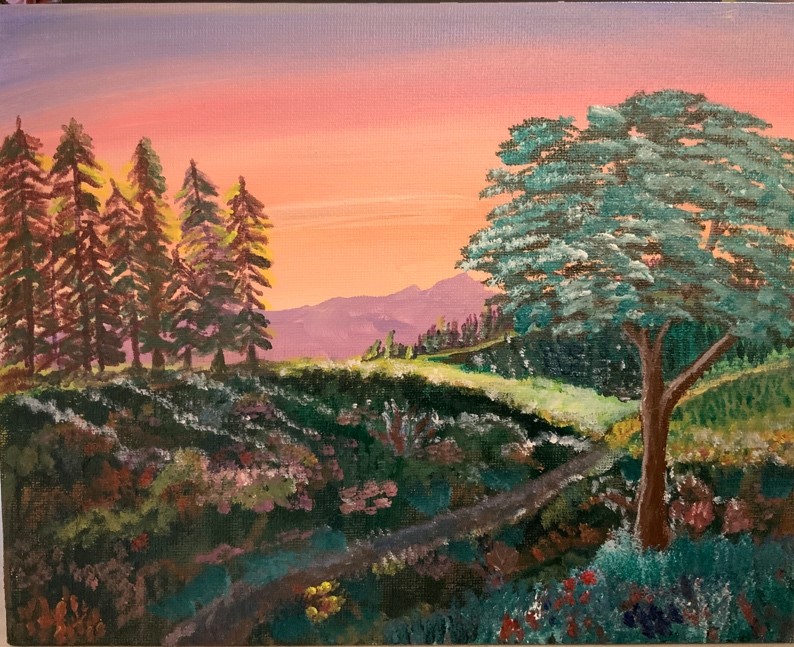
I am able to focus my professional time on the dynamic specialty of multiple myeloma while having improved focus on work/life balance, AND I am able to work from home. This balance has allowed me time to learn artistic painting, which has even influenced the most recent IMF NLB Patient Education presentation as shown in the symptom management section of Advances in Myeloma Treatments: What Patients & Caregivers Need to Know.
This role transition gives me a little different focus for my #ASH21 experience. I will have less focus on transplant, and more focus on specialty aspects of an already specialty diagnosis. I want to focus on the “one-off” versions of myeloma like extra-medullary disease (EMD), plasma cell leukemia (PCL), non-secretory and high risk variants and approaches to treatment.
To that end, I will focus on updates on pipeline combinations and targeted therapies that address novel targets and refractory disease, such as iberdomide and cereblon; venetoclax and t(11;14); and non-B-cell maturation antigen (BCMA) targets, to name a few. Also, I will (always have) focus on supportive care in all phases of the diagnosis as this is key to living well with myeloma.





You must be logged in to post a comment.