The IMF CCO CME Friday Satellite Symposia is a physician educational activity that is available for those who register, either for the online virtual or in-person option.
The diagnosis of active multiple myeloma (MM) and when to initiate therapy for patients with MM continues to evolve as we learn more about the biology of this disease and how we can use various biomarkers to determine the risk of progression to active disease.
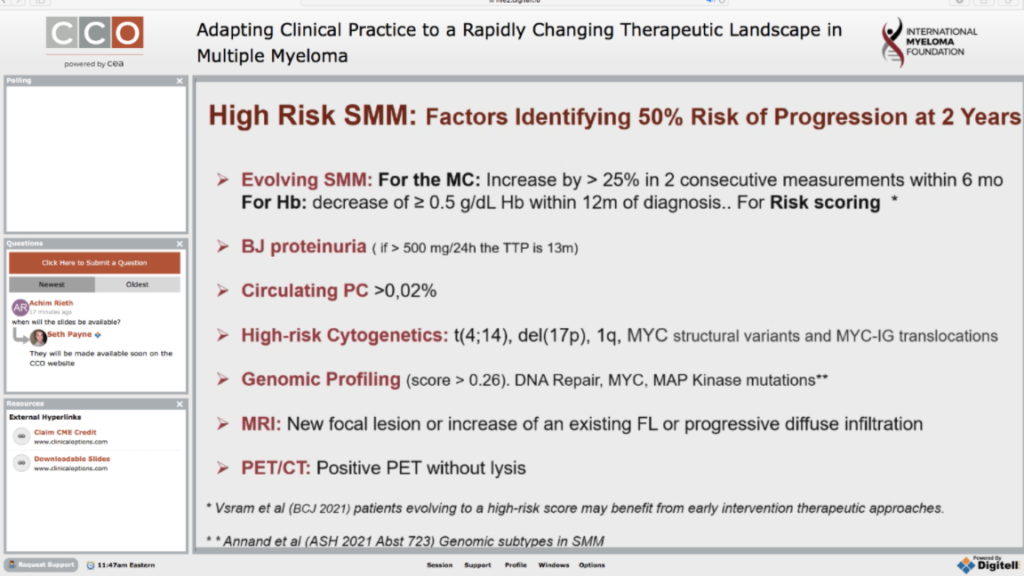
Currently, some consider beginning therapy for patients with smoldering multiple myeloma (SMM) once they have >50% risk of progression to active disease based on the 20/2/20 model. Some healthcare professionals feel uncomfortable and do not wish to start treatment for high-risk smoldering multiple myeloma (HRSMM), and ongoing monitoring happens. Today, we are hearing that we need more than the 20/2/20 model to determine treatment for HRSMM.
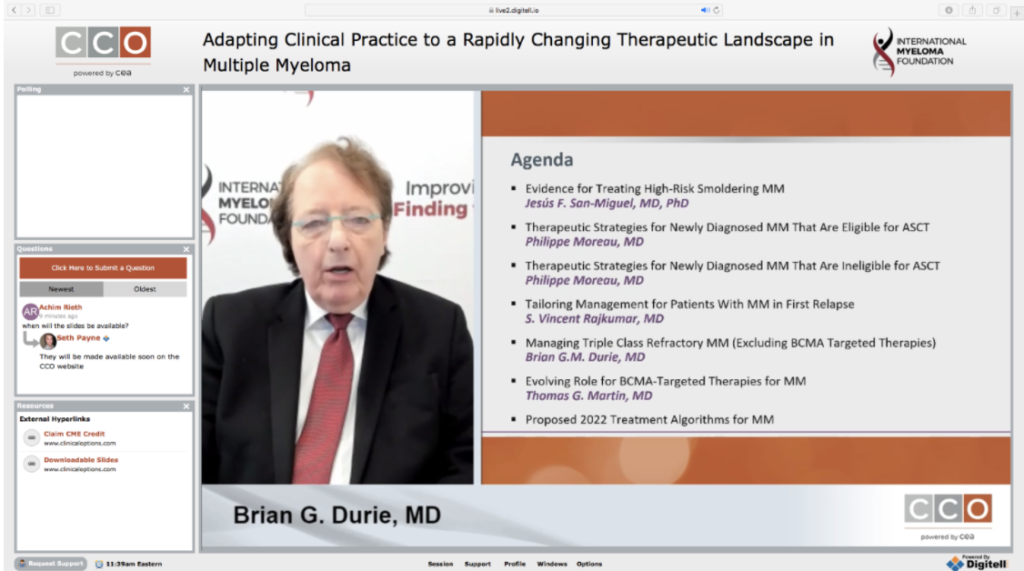
I’m sure some of the other #IMFASH21 Team Leaders will blog on other cases presented at the Symposium, but I’ll focus here on the HRSMM. Below is the excellent agenda for the IMF Symposium where 6 cases were presented, voted on, discussion ensued, voted on again.
Dr. Jesus San-Miguel (Clínica Universidad de Navarra – Pamplona, Spain) presented virtually on “Case Study 1: Evidence for Treating HRSMM.”
To Treat or Not to Treat for HRSMM:
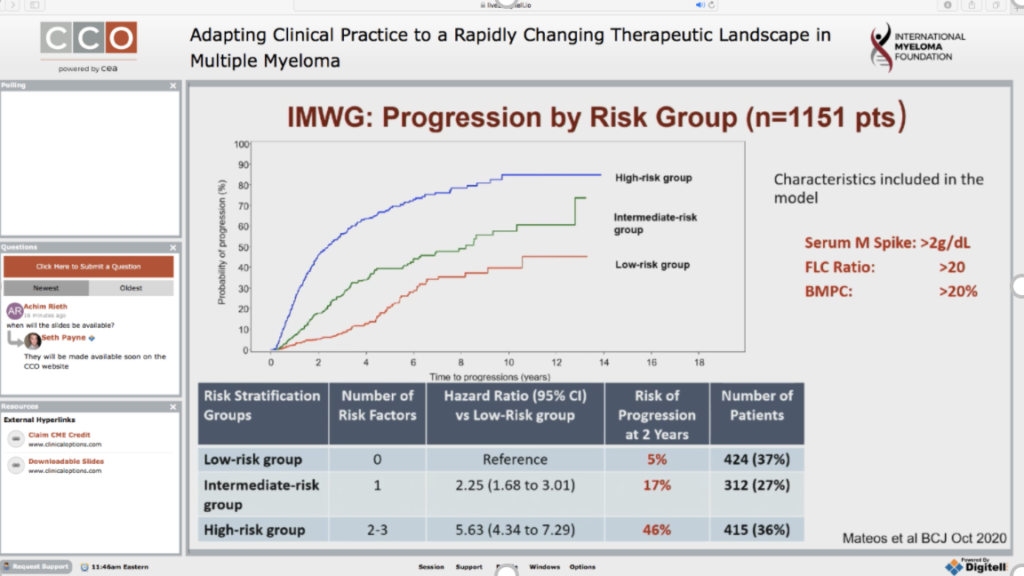
When I was diagnosed 21 years ago, there was not even a classification of HRSMM vs SMM. I remember at previous ASH when these discussions and research first started and the interest that developed. Today we have from the International Myeloma Working Group (IMWG) progression risk by group, see below:
“Having these tools helps a SMM determine to treat or not to treat – but you need more than 2/20/20!” – Dr. Jesus San-Miguel.
Today, my rock n’ roll reference song is “Treat Me Right” by Pat Benatar (1980).
‘Tis the season of gratitude. During these turbulent global times, it is important to embrace the positive aspects of daily living. It is not always easy to identify things to be grateful for, especially if you are facing myeloma, COVID-19, or other personal challenges.
Sometimes, it takes a conscious effort, but it can have a powerful impact on your outlook. I have plenty to be thankful for while attending the 63rd American Society of Hematology (ASH) annual meeting.
I am thankful for:
the support of the International Myeloma Foundation (IMF) and the sponsors to attend the ASH annual meetin virtually, always keeping patient safety in mind.
not having to travel! Did you see how much snow Minnesota got?
my significant other who has already cleared 9 inches of snow!
the replay option for ASH presentations. The information presented is at such a high level and at such a rapid pace, with some technical difficulties, so it is challenging to keep up. I will be spending some time watching ASH replays.
the dedicated medical professionals who continue to do research and clinical practice to improve the life of my Myeloma Family. Despite the added challenges of COVID-19, their dedication has not wavered, as evidenced in the more than 500 programs, posters, and oral presentations. They and their families should be proud of their work.
the amazing support group leaders who bring their perspective to this experience. In attendance are some “veterans” and some “newbies, with all impassioned. The excellent selection of SGLs brings an array of knowledge and personal experiences, representing the spectrum of this complex diagnosis. We have people who represent untreated smoldering myeloma, persistent maintenance therapy, relapsed/refractory myeloma treatment, and stem cell transplant, both Auto and Allo. Each person has an area of interest and is sharing what they learn on social media and with their support group members. Remember, “Knowledge is Power,” and this is one powerful group!
every day of health and well-being for myself and my myeloma family.
I continue to be inspired by and be grateful for the dedication of the myeloma community to improve lives and to search for the cure.
The official start of the American Society of Hematology (ASH) annual meeting is Saturday, but Friday was filled with symposiums sponsored by various organizations.
In my first year attending ASH, I had no idea what to expect from the symposium. Now, I look forward to them. The panel of doctors each presents a patient case and various options for treatment. Attendees are polled about which treatment they would choose. Then the presenter shares data about treatment options. At the end of the panel, they repeat the poll and see how many minds were changed.
Saturday morning started with the International Myeloma Working Group (IMWG) breakfast. Of course, this breakfast started at 6:30 a.m. in Atlanta, which was 4:30 a.m. where I’m at. 🥱. Two years ago, during my first time at ASH, I was so starstruck by the doctors who were part of the IMWG — the Who’s Who of the myeloma world.
Whether we are there in person or virtually, we are flies on the wall. Just observing, but very privileged to be able to watch. I did have a little fun trying to recognize doctors with their masks on!
After the IMWG breakfast, the real fun began with the first oral abstracts. There were many sessions taking place at the same time. There were also technical difficulties, which was frustrating for those of us at home. No video or sound. Then, video but no sound. Then finally, video and sound! I will watch the replays of these presentations later to be able to share my thoughts on the exciting advances in myeloma treatment in my next update.
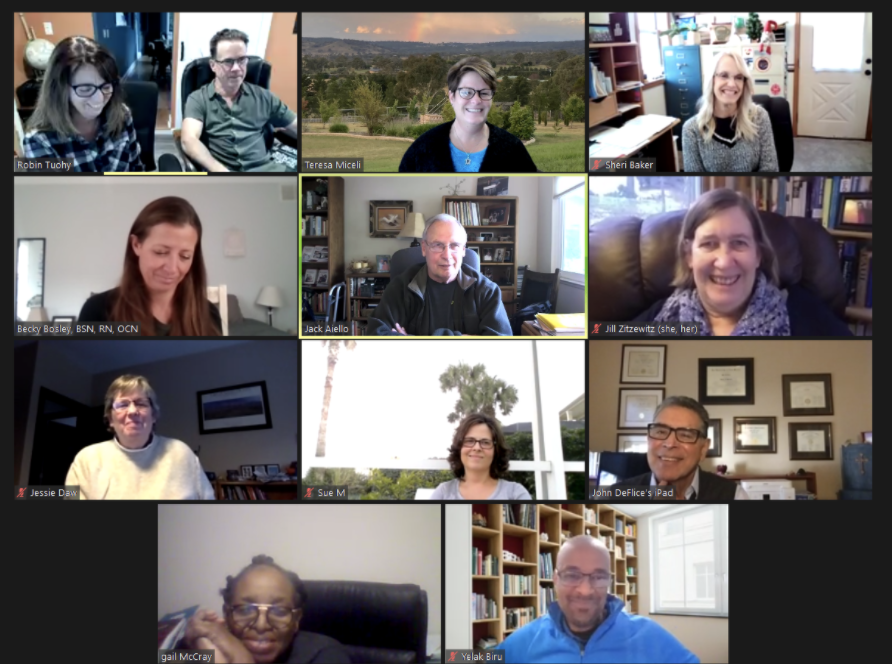
Sheri Baker, Treasure Valley Multiple Myeloma Support Group, Idaho Sheri Baker, on Twitter: @blondie1746
Today was filled with educational symposiums that offered medical professionals attending the 63rd American Society of Hematology (ASH) conference the opportunity to earn continuing education credits.
For me, it provided a glimpse of what is to come this weekend and it reconfirmed that there are many more treatment lily pads that I can leap to in the future. Thanks to the International Myeloma Foundation (IMF) and our generous sponsors, this is my 9th year attending this conference.
Every year offers great insight into the amazing research that is ongoing to find a cure for multiple myeloma. But some years, I feel like there are more leaps than others. I think 2021 will be one of those years pushing future treatment options to the next level. Bispecific antibodies and CAR T-cell therapies have been featured at previous ASH conferences, but the number of options is reaching a new level and new targets being studied provide more ways to outsmart our continually changing myeloma.
With all this advancement comes more choices — another reason to be an informed patient. There will be a greater need to understand the sequence of treatments. For example, can you take a bispecific antibody before having CAR T-cell therapy if they target the same antigen on the myeloma cell? Recently approved new therapies and several on the verge of approval target BCMA. So, this is a question that will be widely discussed this weekend. And there is literally an alphabet soup of new targets being explored, so the options and combinations continue to explode.
Saturday began at 6:30 a.m. (3:30 a.m. for our team members from the West Coast) with the International Myeloma Working Group (IMWG) meeting and was followed by a day filled with abstracts on all these amazing studies.
Stay tuned to all the information our team will be sharing with you over the next few days.
Linda Huguelet, Chattanooga Multiple Myeloma Networking Group
What an amazing and exciting day that kicked off the 63rd American Society of Hematology (ASH) Annual Meeting and Exposition. ASH allows doctors from around the world to present various studies happening within the myeloma community. It is truly amazing to see all of the developments within this area.
In addition, I am so grateful that the meeting has a virtual component. The virtual element allows me to experience the meeting without missing a beat! If I had to attend in person, I would not be able to go. By still permitting a virtual platform, I’m able to see all the wonderful presentations that are full of the latest and greatest updates on myeloma. What a great opportunity!
Furthermore, I want to thank the IMF for this occasion. By attending ASH, I can gain more knowledge, which I can then provide to the members of the MM Families Virtual Support Group. https://www.myeloma.org/support-group/mm-families The MM Families Virtual Support group empowers myeloma patients and their caregivers who have young children. By hearing all this newfound knowledge, I hope to encourage them on their journey!
To kick off the first day of ASH, the IMF led a wonderful discussion panel which focused on the following: High-Risk Smoldering Patients; Therapeutic Strategies for Newly Diagnosed Myeloma Patients Both Eligible for Transplant and Not Eligible for Transplant; Tailoring Therapies for First Relapse; Managing Triple-Class Refractory Myeloma, and BCMA-Targeted Therapies.
It was so interesting to hear all the discussions and studies on these various topics. One of the most interesting items that I learned was the development in treating high-risk smoldering multiple myeloma (SMM). Wow! How times have changed! While there is still debate on whether to treat SMM or take the “watch and wait” approach, some of the new studies showed so much promise in treating myeloma early. There was also some interesting data on high-risk patients and tandem transplants, as well as discussion between triplet and quadruplet therapies. In addition, there are so many interesting new studies relating to CAR T.





You must be logged in to post a comment.