Day 3 of ASH was another whirlwind of talks, and even for this scientist, all the details were beginning to blur together. I heard talks that ranged in focus (1) from understanding the molecular basis of disease; (2) to delineating the role of precursor conditions in myeloma progression; (3) to developing the best diagnostic approaches to track disease; (4) to analyzing clinical trial outcomes in order to measure therapy effectiveness. Throughout the day, I found myself noticing a common theme in these very differently focused talks.
The role of the myeloma patient was very central to all of the talks I attended, whether it was (1) using blood or bone marrow samples from myeloma patients in research; (2) deciding when it makes the most sense to start treatment; (3) pondering whether technologies that measure MRD-negativity would allow patients to stop treatment for a time; or (4) thanking the many patients who participated in clinical trials. Every talk had myeloma patients front and center.
As a patient myself, this perspective brings so much hope, knowing that the research is driven by motivation to help patients like me. It makes me realize that myeloma researchers and clinicians are truly motivated by a desire to improve the quality of life for myeloma patients.
Indeed, the International Myeloma Foundation, who brought me to this conference as a patient advocate, has the phrase, “We’re Here for You!” front and center on their website home page, and I felt that community of support throughout this meeting.
I was also very pleased to learn that #ASH21 has both an Antiracism Studio and a Wellness Studio to help their attendees grow as people. I spent some time exploring both of these studios over the past couple of days. A session on Effectively Engaging Community in Science and Research was a good reminder that, while there has been progress, we still have work to do to ensure that all myeloma patients have access to the best care and clinical trials.
It was good to see several scientific presentations that discussed the inclusion of patients with diverse racial and ethnic backgrounds or patients who were older and frailer. There was also a focus in the scientific questions and answers on the gaps that still needed filling in this area. A session called Ten Minutes to Resilience listed the following critical eight steps: (1) accept change, (2) learn continuously, (3) take charge, (4) define purpose, (5) create balance, (6) cultivate love, (7) reflect, and (8) reframe skills.
Resilience is important for researchers, providers and patients when tackling a challenging disease like multiple myeloma. Our central MA multiple myeloma support group has focused on resilience throughout the pandemic, starting each meeting with a check-in question that focuses on a way we can build resilience. I am so excited to bring back all that I’ve been learning to our group so we can continue to build our resilience as we learn how to manage multiple myeloma together. When we are there for each other, it makes all the difference!
The Friday before the official start of ASH is always considered as Symposium Day. Symposiums typically last a couple of hours and involve several myeloma expert doctors discussing patient cases and various treatment options. Patient cases can vary from smoldering to newly diagnosed, to early and late relapse, and along with them — the consideration of risk factors and comorbidities.
These meetings are sponsored by advocacy organizations: the International Myeloma Foundation, Healthtree Foundation, Research To Practice, as well as Pharma companies. While they don’t include new information that will subsequently be presented at ASH, they provide treatment suggestions currently approved by the FDA as well as consideration of ongoing clinical trials.
In particular, my goal was to listen for insights provided by the specialists and to offer those takeaways in this blog.
After attending 3 symposiums, here’s what I heard:
At an Education Program discussing high-risk MM (HRMM), Dr. María V. Mateos (University of Salamanca – Salamanca, Spain) remarked: “While there’s no specific treatment for HRMM, our goals should be to provide continuous therapy and focus on getting MRD (minimum residual disease) as low as possible.”
Dr. Suzanne Lentzsch (Columbia University Medical Center – New York) noted an important study from Dr. Rafael Fonseca (Mayo Clinic, Rochester, MN) which showed “that 57% of non-transplant eligible patients only get 1 Line of Therapy, so many patients are not getting newer treatments.” [Personally, I’m trying to track down this report.]
Dr. Noa Biran (Hackensack University Medical Center – Hackensack, NJ), when treating relapsed MM, suggested using the TRAP algorithm when making subsequent treatment decisions. T=Timing of relapse; R=Response from prior therapy; A=Aggressiveness of disease; and P=Performance status. This algorithm was reiterated by Dr. S. Vincent Rajkumar (Mayo Clinic, Rochester, MN).
Dr. Biran also noted that “triplets outperform doublets in early relapse.”
Dr. Philippe Moreau (University Hospital Hotel Dieu — Nantes, France) noted that an upcoming study for newly diagnosed MM will show no benefit of adding Ninlaro® (ixazomib) to Rev-dex maintenance.
For non-transplant eligible patients, Dr. Moreau noted: “I think DaraRd till progression [Maia study] is the best treatment for elderly patients. Dr. Rajkumar countered “But VRd for 6 months, then Rev maintenance is more cost-effective, easier on the patient, and also provides excellent results so either treatment choice is okay.”
Dr. Rajkumar’s principles for selecting treatments for relapsed MM: 1) use a triplet; 2) change 2 drugs; 3) consider a transplant; 4) consider a clinical trial.
Dr. Thomas Martin (University of California SF – San Francisco, CA) predicted: “Ultimately bispecifics will be used in all lines of therapy and CAR T will replace transplant.”
Dr. Morie Gertz (Mayo Clinic — Rochester, MN) “If Blenrep® is working, don’t give up due to ocular side effects. Rather, try dose adjustment, give less frequently, even adding prednisone has helped with eye effects…don’t give up.”
For triple-class refractory patients, both Drs. Martin and Gertz commented that the alkylating agent cytoxan should be considered if it hasn’t been previously used.
That’s it for tonight. My first meeting tomorrow is at 3:30am PST so it’s early to bed for Day 1 of ASH!
Wow, what an inspiring and exciting day! So much information was jampacked into a few hours! I attended the IMF/CCO Satellite Symposium entitled Adapting Clinical Practice to a Rapidly Changing Therapeutic Landscape in Multiple Myeloma.
A panel of experts discussed six different case studies, including the ability to vote for chosen treatment strategy prior to discussing the case study, and after. This type of approach made me realize how much I DO know about myeloma, because 95% of the time, I choose the treatment option that the majority of attendees choose. However, it also made me realize how much I DON’T know and how much there is still to learn!
The five expert panel members were Dr. Brian Durie (Cedars Sinai L.A.), Dr. Vincent Rajkumar (Mayo), Dr. Thomas Martin (UCSF), Dr. Phillippe Moreau (Nantes, France), and Dr. Jesus San-Miguel (Pamplona, Spain). What a powerhouse of knowledge and deep understanding of myeloma this group has! I was blown away — not just by their knowledge, but also by their ability to translate that knowledge to their audience. The differences between treatment strategies in the US vs Europe were also interesting to hear. The use of Melphalan is much more common there, as an induction drug and as part of a regimen at a lower dose, of course, than during transplant.
The expert panel discussed the risk stratification method to determine progression risk of sMM patients to myeloma. Factors include bone marrow plasma cell percentage, FiSH abnormalities, M Proteins, and FLC Ratio, but they proposed that circulating plasma cells should also be included in workup and risk stratification of sMM, rather than just bone marrow plasma cell percentages. Will this help improve quality of life in the future by not requiring as many serial bone marrow biopsies for patients? This remains to be seen — but anything to improve quality of life excites me!
In addition, there was a discussion about ASCT ineligible patients with myeloma with impressive PFS & OS data for DRd regimen until progression. This data was made even more impressive, as it included the frail elderly population as well.
An easy-to-remember and logical planning acronym for managing myeloma in first relapse was also shared by Dr. Rajkumar. TRAP (timing of relapse, response to prior therapy, aggressiveness of relapse, and performance status) are all factors to consider when making treatment recommendations for this population of patients. Sequential immunotherapies that have different targets were also discussed, i.e., BCMA, GPRC5D.
I am looking forward to the 24-month PFS data from the Cartitude trial that will be shared on Sunday. Data, so far, is undoubtedly positive which hopefully means good things in the future!
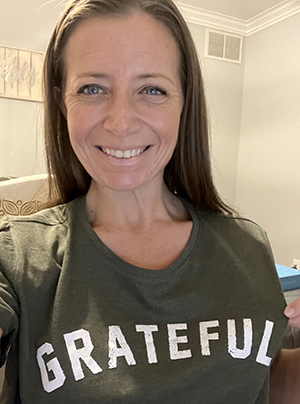
Time to reset, eat dinner, and spend some time with my family for the evening. Looking forward to what tomorrow brings! Knowledge is power and I can’t wait to continue to learn and grow so that I can pass that information along to my support group members. I can’t begin to express how grateful I am, both to the IMF and to our sponsors, Takeda, Karyopharm Therapies, and Bristol Myers Squibb for making my attendance and participation possible at ASH 2021. I even wore my GRATEFUL shirt! Until tomorrow…




You must be logged in to post a comment.