

Wow, what an inspiring and exciting day! So much information was jampacked into a few hours! I attended the IMF/CCO Satellite Symposium entitled Adapting Clinical Practice to a Rapidly Changing Therapeutic Landscape in Multiple Myeloma.
A panel of experts discussed six different case studies, including the ability to vote for chosen treatment strategy prior to discussing the case study, and after. This type of approach made me realize how much I DO know about myeloma, because 95% of the time, I choose the treatment option that the majority of attendees choose. However, it also made me realize how much I DON’T know and how much there is still to learn!
The five expert panel members were Dr. Brian Durie (Cedars Sinai L.A.), Dr. Vincent Rajkumar (Mayo), Dr. Thomas Martin (UCSF), Dr. Phillippe Moreau (Nantes, France), and Dr. Jesus San-Miguel (Pamplona, Spain). What a powerhouse of knowledge and deep understanding of myeloma this group has! I was blown away — not just by their knowledge, but also by their ability to translate that knowledge to their audience. The differences between treatment strategies in the US vs Europe were also interesting to hear. The use of Melphalan is much more common there, as an induction drug and as part of a regimen at a lower dose, of course, than during transplant.
The expert panel discussed the risk stratification method to determine progression risk of sMM patients to myeloma. Factors include bone marrow plasma cell percentage, FiSH abnormalities, M Proteins, and FLC Ratio, but they proposed that circulating plasma cells should also be included in workup and risk stratification of sMM, rather than just bone marrow plasma cell percentages. Will this help improve quality of life in the future by not requiring as many serial bone marrow biopsies for patients? This remains to be seen — but anything to improve quality of life excites me!
In addition, there was a discussion about ASCT ineligible patients with myeloma with impressive PFS & OS data for DRd regimen until progression. This data was made even more impressive, as it included the frail elderly population as well.
An easy-to-remember and logical planning acronym for managing myeloma in first relapse was also shared by Dr. Rajkumar. TRAP (timing of relapse, response to prior therapy, aggressiveness of relapse, and performance status) are all factors to consider when making treatment recommendations for this population of patients. Sequential immunotherapies that have different targets were also discussed, i.e., BCMA, GPRC5D.
I am looking forward to the 24-month PFS data from the Cartitude trial that will be shared on Sunday. Data, so far, is undoubtedly positive which hopefully means good things in the future!
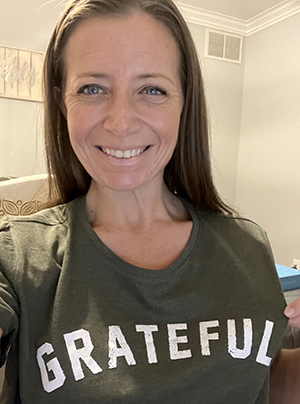
Time to reset, eat dinner, and spend some time with my family for the evening. Looking forward to what tomorrow brings! Knowledge is power and I can’t wait to continue to learn and grow so that I can pass that information along to my support group members. I can’t begin to express how grateful I am, both to the IMF and to our sponsors, Takeda, Karyopharm Therapies, and Bristol Myers Squibb for making my attendance and participation possible at ASH 2021. I even wore my GRATEFUL shirt! Until tomorrow…
Becky Bosley, on Twitter @MidAtlanticMSG
You must be logged in to post a comment.