What an amazing and exciting day that kicked off the 63rd American Society of Hematology (ASH) Annual Meeting and Exposition. ASH allows doctors from around the world to present various studies happening within the myeloma community. It is truly amazing to see all of the developments within this area.
In addition, I am so grateful that the meeting has a virtual component. The virtual element allows me to experience the meeting without missing a beat! If I had to attend in person, I would not be able to go. By still permitting a virtual platform, I’m able to see all the wonderful presentations that are full of the latest and greatest updates on myeloma. What a great opportunity!
Furthermore, I want to thank the IMF for this occasion. By attending ASH, I can gain more knowledge, which I can then provide to the members of the MM Families Virtual Support Group. https://www.myeloma.org/support-group/mm-families The MM Families Virtual Support group empowers myeloma patients and their caregivers who have young children. By hearing all this newfound knowledge, I hope to encourage them on their journey!
To kick off the first day of ASH, the IMF led a wonderful discussion panel which focused on the following: High-Risk Smoldering Patients; Therapeutic Strategies for Newly Diagnosed Myeloma Patients Both Eligible for Transplant and Not Eligible for Transplant; Tailoring Therapies for First Relapse; Managing Triple-Class Refractory Myeloma, and BCMA-Targeted Therapies.
It was so interesting to hear all the discussions and studies on these various topics. One of the most interesting items that I learned was the development in treating high-risk smoldering multiple myeloma (SMM). Wow! How times have changed! While there is still debate on whether to treat SMM or take the “watch and wait” approach, some of the new studies showed so much promise in treating myeloma early. There was also some interesting data on high-risk patients and tandem transplants, as well as discussion between triplet and quadruplet therapies. In addition, there are so many interesting new studies relating to CAR T.
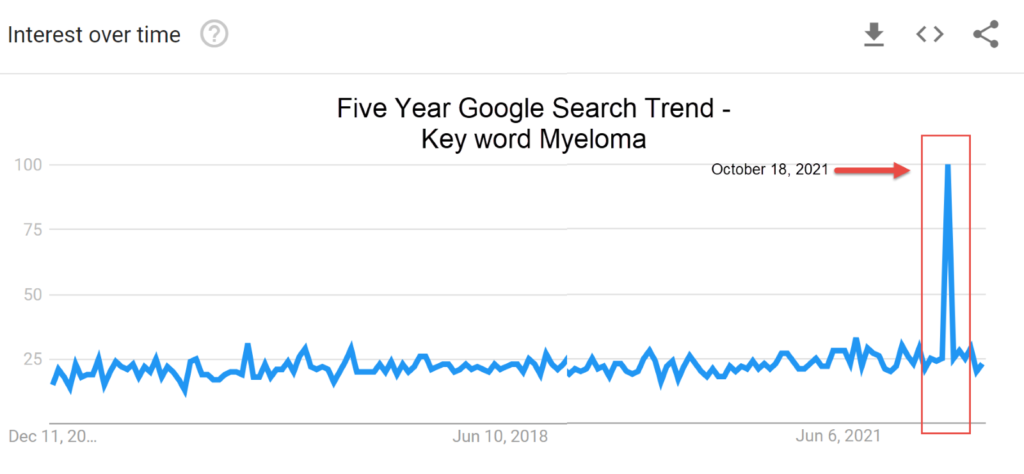
On December 12, 2021, there were 545 open and recruiting clinical trials on the clinicaltrials.gov website. There are over 800 #ASH21 abstracts with the word #myeloma in them. There was a four-fold increase in Google’s keyword trend for #myeloma after the death of Secretary of State General Colin L. Powell. Over 750,000 men, women, and children have died in the US and over 5 million worldwide due to the #COVID19 pandemic. Delta and Omicron COVID variants continue to humble and teach us that collaboration is key to overcoming.
Google Keyword Search Trend for Myeloma
The FDA approved the first BCMA-targeted CAR T-cell therapy for multiple myeloma, Abecma® (idecabtagene vicleucel). The hopeful approval for the second CAR T, cilta-cel, had been delayed by three months but is expected in Q1 of 2022.
This year’s ASH will highlight the progress of several critical research:
MGUS and SMM – Is screening the way to go? What is the psychological impact of “knowing early?” Are African Americans at a higher risk for MGUS and as a result, myeloma? What is the effect of high-dose treatment for SMM patients?
MRD-guided therapy – Can we use MRD to pause treatment? What is the impact of quadruplets on MRD?
CAR T, BCMA therapies – What are the outcomes of phase 1/2 or 2/3 studies for CAR T and BCMA, such as teclistamab, and others that don’t even have a name yet? How about off-the-shelf CAR Ts to alleviate collection and production issues of CAR Ts?
Maintenance – Is maintenance the way to go? Which single or double is best for maintenance? How about QOL, affordability, and impact on subsequent therapies?
The IMF teams will be busy at ASH and will be facilitating either virtual or hybrid meetings:
The Friday IMF Satellite Symposium
International Myeloma Working Group (IMWG) Breakfast
IMWG Conference Series
Global Myeloma Action Network (GMAN) Summit
Best of ASH Conference
The IMF SGLs will be attending ASH virtually, so we won’t have that awkward moment of fist-bumping while someone else is extending a handshake!
There is no other single conference where so much information is presented about myeloma. Information about so many topics is provided: how to treat MM patients in various stages; results of phase II & III trials which may indicate upcoming FDA approvals; treatment considerations of MGUS and smoldering MM patients; pre-clinical research focusing on myeloma targets and cell understanding; and more.
This year, the 63rd American Society of Hematology (ASH) meeting will be a “hybrid” meeting (combination of in-person in Atlanta and virtual via Zoom). I’ll be attending virtually which means that some of my meetings will start at 4am CA time (7am in Atlanta).
I’m so grateful to the International Myeloma Foundation (IMF) and their sponsors for registering me to attend, and I look forward to blogging about each day’s highlights. Finally, I’ll create a multi-page summary of the most interesting takeaways from my perspective and share this with my support group, post it on our website, and distribute to anyone else who requests it.
I attended my first ASH meeting 16 years ago and found it a bit like being diagnosed with myeloma 27 years ago. The terminology and amount of information was overwhelming. This was not surprising though, since the audience consisted of over 30,000 researchers and oncologists, who were learning the latest updates for all blood cancers, including myeloma.
I’ve learned to prepare a few weeks ahead of time and have already reviewed many of the myeloma abstracts while creating my personal agenda of talks that I wanted to view. These presentations are typically oral abstracts of clinical trial results, symposiums (case studies and various treatment considerations) and educational programs rather than biological lab studies.
Meetings I attend have more immediate value to patients undergoing treatment or to the newly diagnosed. By the way, you can also check out the abstracts (a summary of the planned presentations) by visiting www.hematology.org, although numerical details and conclusions of these abstracts are often updated during the actual presentations.
If you’ve been following new MM treatments the last few years, it’s been mostly focused on immunotherapies (treatments which help your own immune system to fight myeloma). This year’s ASH will have even more about mAb’s (monocloncal antibodies), ADC’s (Antibody Drug Conjugates), BiTEs (Bi-specific T-cell Engagers), and CAR-T therapies. I expect to hear updated trial results for all of these various therapies — in particular, BiTEs and CAR-Ts, and will be sharing this information with you.
I will be blogging every night during the Dec 10-13 ASH meeting and will be providing my takeaway highlights presented earlier that day. Along with several other patients/support group leaders the IMF brings to ASH, I look forward to sharing our experiences together via blogging and tweeting.
We hope to keep you well-informed through our individual patient perspectives. Of course, you’ll have other vehicles to learn from about ASH in the weeks to follow, including webinars, telephone conferences, seminars, and more. Maybe your own oncologist will be at ASH. Take advantage of these resources and become your own best patient advocate.
“Research is to see what everybody has seen, and to think what nobody else has.”
Albert Szent-Gyorgyi
I tweeted the above quote after Dr. Ola Landgren (Sylvester Comprehensive Cancer Center at the University of Miami — Florida) had spoken to our International Myeloma Foundation (IMF) virtual support group in New Mexico.
Dr. Landgren, a myeloma expert, discussed new myeloma treatments and shared his new lines of research at the Sylvester Comprehensive Cancer Center in Miami—South Florida’s only NCI-designated Cancer Center. Listening to Dr. Landgren speak to our group reminded me of just how far myeloma researchers and clinicians have come in the development of myeloma treatments.
Thalidomide was first introduced as a myeloma treatment at the University of Arkansas by Dr. Bart Barlogie. Back then, the five-year survival for a newly diagnosed myeloma patient was 34% nationally. With the therapeutic advances today, we can look to overall survival from 1-3 years to 10-20 years. We also have a tremendous amount of excitement about the possibility of curing myeloma by treating high-risk monoclonal gammopathy of undetermined significance (MGUS) and high-risk smoldering myeloma (HRSMM).
Since my diagnosis in 2010, I have become so encouraged by the various treatment advances. Such advances include CAR T-cell therapy, novel bispecific antibody therapy, and new modalities to measure minimal residual disease (MRD) in early relapsed disease, along with improved imaging techniques.
Also, the advancement of genomics in multiple myeloma suggests that targeted treatment may become available in the future. I’m very excited to hear about all the research that will be presented at ASH 2021, and I am especially grateful to be part of this conference as an IMF support group leader.





You must be logged in to post a comment.