When I was first diagnosed with myeloma in the Spring of 2010, one of my biggest concerns was the number of approved treatments and who would be doing research on a cancer that affects relatively few people. I quickly learned that there was a very active research scene for myeloma and one of my doctors told me that like frogs on lily pads, I would leap from one treatment to another as needed.
I’m now on my 4th lily pad and began taking my current treatment regimen of Pomalyst (pomalidomide), Darzalex (daratumumab), and dexamethasone in May 2018. When I started this combination, my specialist told me that patients at his institution had a median of 48 months on this therapy. I’m not sure if that number has changed, but I’ve always wondered if I would be “above average” and surpass the 48-month mark. My previous therapies have not had this length of duration for me. I remain hopeful that in the Spring of 2022, I will surpass 4 years with this treatment and be able to continue with my once monthly visits to the treatment center for a relatively quick visit, thanks to Darzalex Faspro that replaced my infusions with injections in mid-2020.
At the time of my diagnosis, neither Pomalyst or Darzalex were approved and monoclonal antibodies like Darzalex were gaining traction on the research scene. I attended my first American Society of Hematology (ASH) conference in 2013 and the number of myeloma clinical trials, known as abstracts at ASH, seem to grow each year.
This year, over 600 abstracts that will be presented. They are presented either orally or as a poster-board display during the conference. The oral presentations tend to be on research that is a little further along than those presented as a poster.
As a layman listening to the scientific research behind these abstracts, they appear to have become more complex and more refined since I first began attending ASH. By this, I mean that the researchers are looking at more complex combinations and looking at more specific targets on the myeloma cells.
Researchers continue to seek knowledge to change myeloma treatments — from a one-size-fits-all approach to a more customized approach that will use selected therapies based on your type of myeloma. So instead of just leaping to the next closest lily pad, we can view all the lily pads ahead of us and decide which one will treat our type of myeloma most effectively.
At this year’s ASH, my interest in monoclonal antibodies continues, along with the larger landscape of treatments available to relapsed and refractory patients like me. I will be reporting on the highlights from these categories and will let you know where you can find more detailed information.
Many thanks to the International Myeloma Foundation (IMF) and pharmaceutical company sponsors who provided the resources for our team to participate in this year’s conference. In many ways, I expect my 2nd virtual ASH to be no different than attending in person.
It will be filled with full days and some information overload, but I’m excited to learn more and share the new innovations with you. Be sure to check out my blogs and tweets on Twitter throughout the conference!
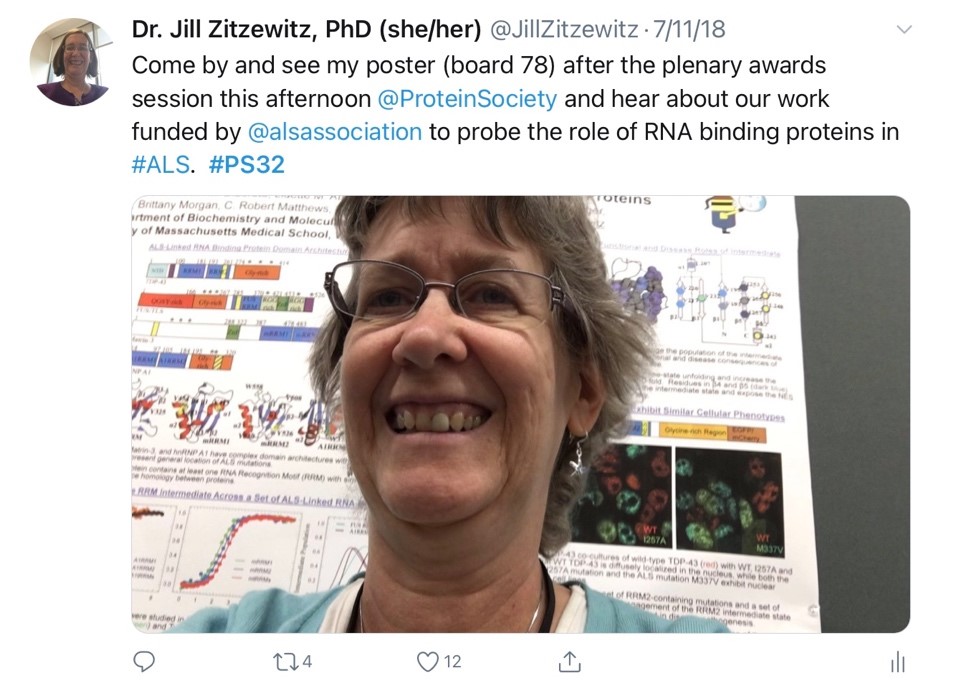
My prior identity as a scientist often flows uneasily with my new identity as a multiple myeloma patient advocate. In my career as a scientist in academic medicine, I’ve attended many national and international meetings where I’ve presented my research on protein misfolding. I’ve always loved the excitement of new ideas and the connections between scientists at meetings working toward a common goal.
Five years ago, I attended an RNA biology meeting in San Diego and had trouble sitting through the meeting sessions or standing during my presentation. I was exhausted and napping during the breaks rather than hanging out with my colleagues. I didn’t know it yet, but multiple myeloma was taking over my bone marrow, bone lesions were developing, and misfolded antibody proteins were showing up in my blood. I was becoming a human model system for a process I studied in the lab in test tubes and cells. This connection of my science focus to my disease was often unsettling, and yet curiously inspiring, and it ultimately helped me learn to use my educational background to help myself and others navigate living with multiple myeloma.
Soon after that meeting, I began getting compression fractures and experienced severe bone pain. The two months before I received a diagnosis of multiple myeloma were a blur of pain and grant writing. I was both relieved and terrified when I finally learned the cause of my symptoms, and I knew I needed to educate myself about this disease and find support to help navigate the days ahead.
I posted on Facebook about my diagnosis, and one of my friends mentioned that her cousin led a local support group. I spent two hours on the phone with Denis, as he walked me through what to expect with the induction therapy and stem cell transplant process, and then I joined the Central MA Multiple Myeloma Support Group of the International Myeloma Foundation (IMF) that Denis led. It brought me so much hope to find a community of support in those early days.
Soon after the COVID-19 pandemic started, I took over as the support group leader for our central MA myeloma group after the devastating death of Denis. It was a time of such sorrow and confusion as we tried to navigate switching to virtual meetings while grieving Denis. Yet, the myeloma patients and care partners who attended our meetings continued to provide a healing community that is focused on caring for each other and finding joy in each day.
About a year and a half after my initial diagnosis, my myeloma was under control with the help of current standard therapies such as Velcade (bortezomib), a proteasome inhibitor that blocks the cell’s garbage can for misfolded proteins.
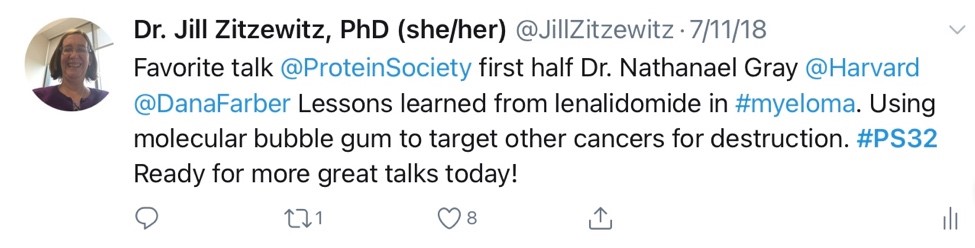
I was back at another scientific meeting — this time, in a meeting in Boston that was focused on protein science. I heard a talk by Nathanael Gray, PhD, (now at Stanford University) on “lessons learned from lenalidomide” (marketed as Revlimid) to develop new therapies to target different diseases.
How cool it was to learn more about how Revlimid, the drug that I was taking for maintenance therapy, actually worked! The drug acts as a sort of “molecular glue” sticking two proteins together, directing a large protein complex to the cell’s garbage can for degradation. It’s pretty complicated and I’m simplifying the details, but by understanding this mechanism of action for the first time, new protein degraders could be designed to target other proteins in other diseases.
I was so excited about the talk, I joined Twitter that very night and sent my first tweet! That meeting was the last meeting I attended to present my own scientific research, and soon after, I transitioned my faculty appointment to a fully educational role because myeloma had made it increasingly difficult for me to manage the physical demands of bench science. Because of that meeting, I also realized that I wanted to be a patient advocate, using my science and education background to provide a unique perspective to those in the myeloma community.
I am so excited to be attending the 63rd American Society of Hematology Annual Meeting (ASH21) this year! Of the many scientific meetings that I’ve attended, this one is an important first for me. Yes, this will be the first time I will be attending ASH, although I’ve followed the meeting closely on Twitter and through the IMF blogs these past few years.
More importantly though, this will be the first time I will be attending ASH as a patient advocate. I am so incredibly grateful to the IMF and the pharmaceutical sponsors for providing this opportunity. I can’t wait to learn and share about new therapies on the horizon that will continue to provide hope for myeloma patients and their families.
“Research is to see what everybody has seen, and to think what nobody else has.”
Albert Szent-Gyorgyi
I tweeted the above quote after Dr. Ola Landgren (Sylvester Comprehensive Cancer Center at the University of Miami — Florida) had spoken to our International Myeloma Foundation (IMF) virtual support group in New Mexico.
Dr. Landgren, a myeloma expert, discussed new myeloma treatments and shared his new lines of research at the Sylvester Comprehensive Cancer Center in Miami—South Florida’s only NCI-designated Cancer Center. Listening to Dr. Landgren speak to our group reminded me of just how far myeloma researchers and clinicians have come in the development of myeloma treatments.
Thalidomide was first introduced as a myeloma treatment at the University of Arkansas by Dr. Bart Barlogie. Back then, the five-year survival for a newly diagnosed myeloma patient was 34% nationally. With the therapeutic advances today, we can look to overall survival from 1-3 years to 10-20 years. We also have a tremendous amount of excitement about the possibility of curing myeloma by treating high-risk monoclonal gammopathy of undetermined significance (MGUS) and high-risk smoldering myeloma (HRSMM).
Since my diagnosis in 2010, I have become so encouraged by the various treatment advances. Such advances include CAR T-cell therapy, novel bispecific antibody therapy, and new modalities to measure minimal residual disease (MRD) in early relapsed disease, along with improved imaging techniques.
Also, the advancement of genomics in multiple myeloma suggests that targeted treatment may become available in the future. I’m very excited to hear about all the research that will be presented at ASH 2021, and I am especially grateful to be part of this conference as an IMF support group leader.




You must be logged in to post a comment.