
In my scientific career as a protein scientist studying protein misfolding, I’ve always been a little protein-centric in my view of biology. It’s a bit ironic because I work at an academic institution that is an RNA mecca, where many of my colleagues are doing amazing research understanding the role of RNAs in biology.
Simplistically, proteins do all the work in the cell. DNA gets all the glory, but RNA is the master regulator controlling the fate of each cell. How exciting it was for me to see proteins (specifically antibodies) playing such a major role in myeloma treatment on this first day of #ASH21!
One of the biggest take-home lessons for me today: Darzalex® (daratumumab) is the current “darling” of myeloma treatment strategies. Maybe I’m being biased because I love proteins, but it was awesome to see proteins as powerhouses of therapy in myeloma. There were many talks that discussed clinical trial data showing daratumumab and other CD38+ antibodies’ increased progression-free survival when added as a 4th agent to standard triplet regimes in newly diagnosed patients or when included as part of a new triplet regimen for relapsed myeloma.
During the International Myeloma Foundation sponsored session on “Adapting Clinical Practice to a Rapidly Changing Therapeutic Landscape in Multiple Myeloma”, there was a related thought-provoking discussion led by Dr. S. Vincent Rajkumar (Mayo Clinic – Rochester, MN) on the importance of shared decision-making between myeloma patients and their myeloma specialists when making decisions about next steps in treatment because of the complexity of issues that each patient faces.
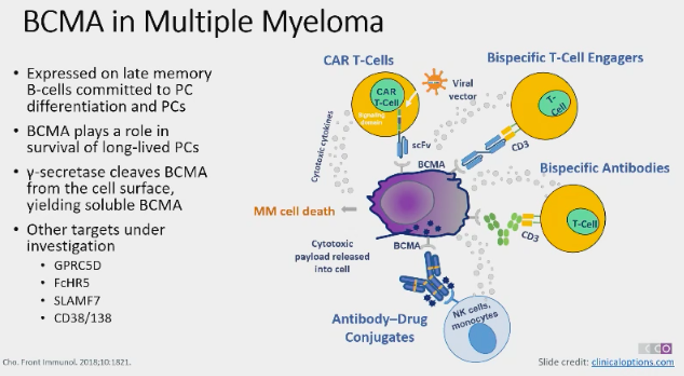
For patients who are refractory to immunomodulators, proteasome inhibitors, and CD38+ antibodies, clinical trial data reported showed BCMA-targeted therapies to be very promising, with response rates of >60% in heavily pretreated myeloma patients. These therapies include FDA-approved CAR T cells and the antibody drug conjugate Blenrep® (belantamab mafodotin), which has a manageable ocular toxicity. Additionally, several bispecific T cell engagers (BiTEs) are anticipated to obtain FDA approval in the next few years. These BCMA-targeted therapies are changing the treatment landscape for relapsed/refractory myeloma and providing new hope.
I found myself thinking a lot about shared decision-making between a myeloma specialist and a patient whenever there is a progression of disease. Making a next therapy decision is a very personal decision — influenced by toxicities, comorbidities, cost, access to care and so many other things. For me, I tend to want to focus on hitting my myeloma hard to prevent the development of drug-resistant clones so I can be around long enough to see my four kids become thriving adults.
I’m grateful that I moved to a combination CD38+ antibody/immunomodulator/steroid therapy line at the very first hint of relapse, right when the pandemic started. I am so grateful for my myeloma specialists, Dr. Muthalagu Ramanathan (UMass Memorial Health Care – Worcester, MA) and Dr. Giada Bianchi (Dana-Farber Cancer Institute – Boston, MA) who have helped me navigate my own therapy decisions.
I enjoyed following the #ASH21 meeting on Twitter, including attending my first @TwitterSpace today hosted by Dr. S. Vincent Rajkumar. I also smiled when I read this tweet about a talk by Dr. Nina Shah(University of California – San Francisco, CA) :
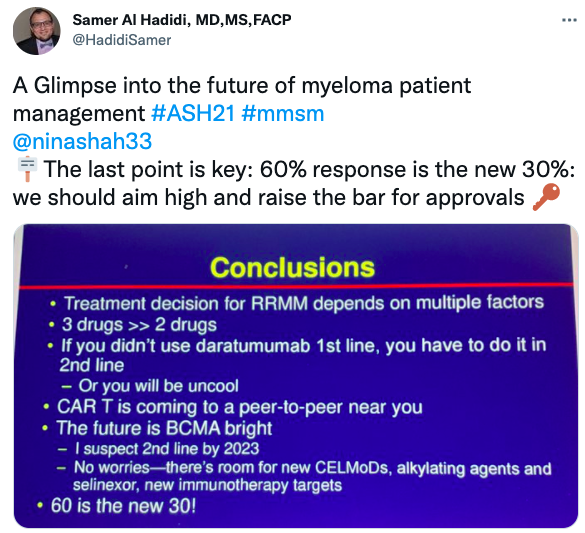
I’m glad that my myeloma specialists and I are “cool,” as I am using daratumumab for a 2nd line. I’m also excited about all these other key points about treatment options for relapsed/refractory myeloma, and I am looking forward to learning about other new targets in the pipeline, like CELMoDs and other immunotherapies in the days ahead.
Today, I heard data that made me even more confident about my decision to start a new line of therapy 21 months ago. I learned that circulating tumor cells predict risk of progression for smoldering myeloma patients. I also really enjoyed a talk by Dr. Giada Bianchi which discussed the role of the tumor microenvironment in the progression from MGUS to SMM to myeloma. I enjoyed thinking about how changes in the bone marrow milieu can influence progression of myeloma, and it was striking to me that changes in both protein and miRNA levels were playing a role in this interaction between the bone marrow components and the plasma cells in a way that leads to progression.
Specifically, bidirectional exchange of exosomes (vesicles that deliver lipids, proteins and nucleic acids) between myeloma plasma cells and components of the bone marrow niche supports pathogenesis. As a scientist, it makes sense to me to hit my myeloma hard to limit the development of new myeloma clones, and I’m so grateful that I, so far, have been able to manage the side effects of treatment and to continue teaching that I love.
It seems like proteins are indeed becoming powerful players in the development of new therapies, and new technologies like single-cell RNA sequencing will also help develop new biomarkers and therapies for myeloma patients with aggressive disease.
Yay Proteins! Yay RNAs too!
Jill Zitzewitz, PhD, on Twitter @JillZitzewitz
You must be logged in to post a comment.